
 Apple Podcasts
  Spotify
  YouTube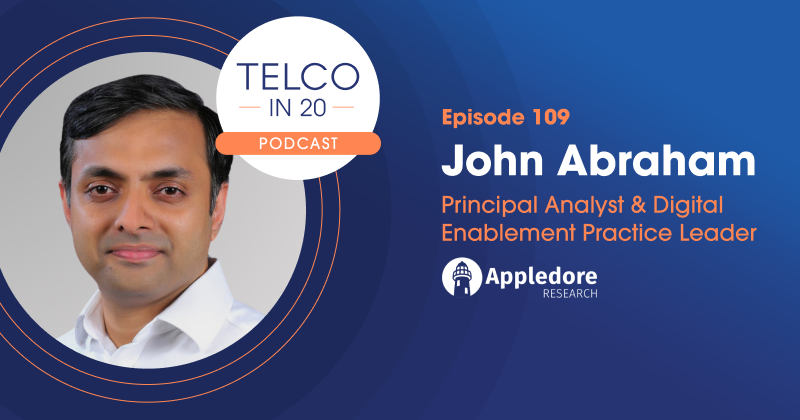
Ep 109 – The power of agentic AI with Appledore Research (John Abraham)
As telcos race to embrace AI, Appledore Research's John Abraham weighs in on agentic AI, the next generation of BSS, and where operators will find true business value.
The Big Three hyperscalers each hit an all-time high in CapEx spending in 2024, collectively investing almost $200 billion. For this episode, I speak with Charles Fitzgerald, managing director at Platformonomics, whose annual “Follow the CAPEX” report tracks the cloud providers’ spending. He pulls back the curtain on what’s driving investments, how AI and nuclear power are coming into play, and whether telcos have what it takes to sell AI workload capacity at the edge. Listen now to hear:
Wanna talk AI and public cloud? Telco execs, set up a meeting with our team to learn how to tap the immense business value it can bring.
Charles Fitzgerald is a Seattle-based angel investor, with a focus on developer platforms and infrastructure. Previously, he spent 20+ years working on platform businesses at Microsoft and VMware. He can see the cloud from his house.
The Telco in 20 podcast is ranked in the top 5% of all podcasts globally by Listen Notes! 🎉 We’ve also won a 2024 MarComm Award and Hermes Award, and are recognized as a TeckNexus Top 12 Telco and Tech Podcast, Forrester Top 100 Channel Podcast and Feedspot Top 10 Telecom Podcast.
If you enjoy the podcast, would you leave us a review? It takes you seconds to do in your app and it really makes a difference in helping to convince hard-to-get guests. And I love reading your feedback and reviews!
 Get my FREE newsletter, delivered every two weeks, with curated content to help telco execs across the globe move to the public cloud.
Set up a meeting with our team to learn how to tap the immense business value it can bring.

The four major hyperscalers—Amazon, Microsoft, Google, and Meta—collectively spent over $250 billion on CapEx in 2024, up 62% from 2023. Amazon led with $83.9 billion total (with $53.3 billion specifically for AWS infrastructure), followed by Microsoft at $75.6 billion, Google at $52.5 billion, and Meta at $39 billion. All four companies posted all-time highs and forecasted even higher spending for 2025, driven primarily by AI infrastructure investments. Read Charles Fitzgerald’s 2024 retrospective on public cloud CapEx spending for detailed analysis.
Cloud providers are embracing nuclear power because AI data centers require enormous amounts of electricity that isn’t readily available on existing grids. It can take years to connect new data centers to the grid, and facilities are moving toward consuming a gigawatt of power each. Amazon, Microsoft, Google, and Meta have all announced nuclear power deals, including reopening existing plants and investing in small modular reactors, though these new reactors won’t come online until the 2030s. Learn more about the hyperscalers’ nuclear energy plans and check out the Cloud Reactor Tracker.
Telcos face three critical challenges in selling AI workload capacity at the edge. First, they need access to scarce NVIDIA GPUs, and they’re not at the front of the allocation line. Second, they require massive amounts of electricity—potentially a gigawatt of incremental power—which hyperscalers are acquiring by restarting nuclear reactors. Third, they lack sophisticated software capabilities to manage AI workloads at scale, competing against companies with decades of infrastructure experience and top engineering talent. Read about telcos’ aspirations to make money from AI infrastructure: Verizon execs hint at making money from AI infrastructure and AT&T and Verizon are pivoting into the landlord biz for AI.
In her Telco in 20 takeaway, Danielle Rios advises telcos to focus on their core strength: building and operating world-class networks. She emphasizes that just operating networking technology does not make telcos technology companies—a critical distinction when competing with hyperscalers. Rather than trying to compete in AI infrastructure where they lack advantages in chips, power, and software expertise, telcos should own their superpower—connectivity—and consider solutions like Totogi’s BSS Magic.
Stargate is a $500 billion AI infrastructure project led by SoftBank, OpenAI, Oracle, and MGX that aims to build 20 new mega data centers to keep the US ahead in AI. Charles Fitzgerald is skeptical, noting that deploying CapEx at large scale requires sophisticated manufacturing capabilities that take years to develop. He feels the project partners lack experience, and notes that OpenAI recently hired its first data center employee, Oracle runs “nano data centers,” and the headline numbers keep escalating unrealistically from $100 billion to $5 trillion in weeks.
Telcos have been dramatically outpaced by hyperscalers in CapEx spending. In 2024, Amazon, Google, or Microsoft each individually spent more than AT&T, T-Mobile, and Verizon combined. Those three telcos collectively saw their CapEx decline by 5% in 2024, while hyperscalers increased spending by 62%. Despite telcos’ interest in pivoting into the AI infrastructure business, they lack the scale of investment that hyperscalers maintain. In the 21st century, the three major cloud providers have collectively spent over a trillion dollars on CapEx.