 Apple Podcasts
  Spotify
  YouTube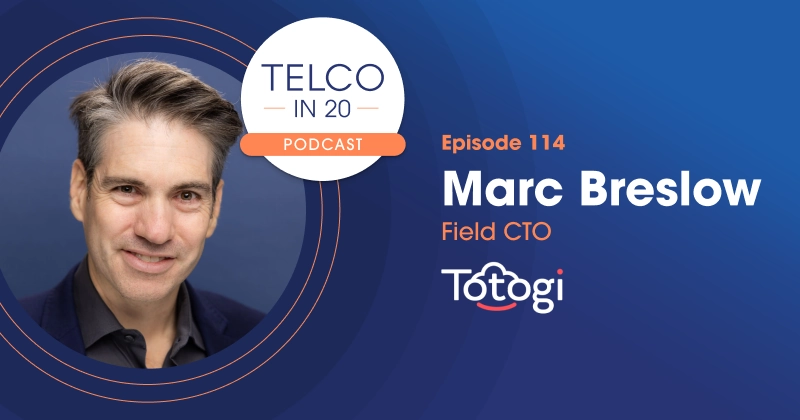
Ep 114 – What’s up with Totogi: The ontology of BSS Magic
BSS Magic creates a telco specific Palantir platform that builds a digital twin enabling AI to reason across your systems.
In today’s rapidly evolving tech landscape, operators struggle with change because they are held back by their legacy systems and rigid processes. Bold transformation isn’t just about upgrading networks or cutting costs—it requires fundamentally redesigning how the entire organization works. The future belongs to those with the courage to drive radical change — which is absolutely necessary in the age of AI and cloud.
For this episode, I’m talking with Mark Sanders, Chief Architect and Head of Autonomous Networks and AI Enablement at Telstra, about their composable architecture. Telstra is building on TM Forum’s ODA to create a revolutionary framework that arranges telco knowledge into an ontology. We dive into how Telstra is leveraging a composable architecture to build an autonomous network, and using AI to create a future-ready organization.
Listen now to hear:
Wanna talk AI and public cloud? Telco execs, set up a meeting with our team to learn how to tap the immense business value it can bring.
Mark is a transformational leader working in the intersection IT, Networks, Data and AI in telecommunications. Mark stands at the forefront of emerging technology for Telcos: Decoupled and composable architectures, Orchestration, APIs, AI, and Autonomous network services. Leading the innovation that will transform how Telco builds, activates, and lifecycle Services. As the Chief Architect, Mark assumes responsibility for developing comprehensive architecture strategies, and technology patterns across the enterprise and cross-domains at Telstra. In collaboration with Telco and Standards Development Organizations, he plays a pivotal role in shaping the industry and influencing Telco Architecture. Mark leads a team dedicated to providing enterprise-wide technology leadership. Their primary objectives include ensuring compliance with the Telstra Reference Architecture Model, minimizing technical debt, facilitating cross-domain decision-making, and contributing to optimal technology choices.
The Telco in 20 podcast is ranked in the top 5% of all podcasts globally by Listen Notes! 🎉 We’ve also won a 2024 MarComm Award, a 2024 and 2025 Hermes Award, and are recognized as a TeckNexus Top 12 Telco and Tech Podcast, Forrester Top 100 Channel Podcast and Feedspot Top 10 Telecom Podcast
If you enjoy the podcast, would you leave us a review? It takes you seconds to do in your app and it really makes a difference in helping to convince hard-to-get guests. And I love reading your feedback and reviews!
 Get my FREE newsletter, delivered every two weeks, with curated content to help telco execs across the globe move to the public cloud.
Set up a meeting with our team to learn how to tap the immense business value it can bring.

Telstra’s Reference Architecture Model (TRAM) is built on TM Forum’s Open Digital Architecture (ODA) and uses a “LEGO block” approach to technology. Instead of tightly coupled legacy systems that resist change, TRAM defines discrete technology components with clear interfaces that can be assembled and reassembled quickly. This composable architecture puts innovation in the hands of the right people, allowing teams to create new products faster and more efficiently.
Telstra is making a fundamental shift from process-driven automation to outcome-driven autonomy. Traditional automation still requires network engineers to write code and scripts for every process; autonomous networks focus on defining desired outcomes and arranging data into structured knowledge. The network then acts on this knowledge independently, deciding what actions to take to achieve those outcomes. This shift requires organizing telco knowledge into an ontology that AI systems can reason with and act upon.
A telco-specific ontology is a structured knowledge framework that codifies how telco business objects, processes, and relationships work together. As Danielle Rios from Totogi explains, it embeds knowledge about the “nouns and verbs” of running a telco—products, subscribers, networks, and their interactions. Instead of relying on hard-coded workflows or on individual judgment, AI agents can use this ontology to reason and make optimal decisions. Both Telstra and Totogi are developing ontologies to enable agentic AI to transform network operations and BSS processes. Discover how Totogi’s BSS Magic leverages ontology.
Mark Sanders believes incremental change isn’t enough in today’s rapidly evolving landscape. True disruption requires rethinking not just technology, but how that technology changes work processes, organizational culture, and customer interactions. This requires bold leadership from the board and executive team willing to take risks and persist through setbacks. Telstra recognizes that embracing disruptive technologies like AI and autonomous networks demands a different approach—one that goes beyond innovation to the genuine transformation of how the entire organization operates.
DR uses a mountain-climbing metaphor: if you’re going to fundamentally transform your organization, you need to “get on the mountain” now rather than wait on the sidelines. There will be setbacks, new models, and challenges—AI advancement has a “jagged edge” with occasional steps backward. But organizations that want to reach the summit must start climbing with their mountaineering gear today. Waiting for perfect conditions or stable technology means never starting the journey. Check out DR’s talk on avoiding vendor lock-in with TM Forum Open APIs.
TM Forum’s standards are foundational to Telstra’s three strategic pillars: composable architecture, autonomous networks, and data/AI. Telstra actively collaborates with TM Forum on industry APIs that simplify integration and enable reusability, the Open Digital Architecture that underpins its TRAM framework, and emerging autonomous network initiatives. Sanders emphasizes that industry collaboration through TM Forum helps all operators mature together and solve common challenges.