 Apple Podcasts
  Spotify
  YouTube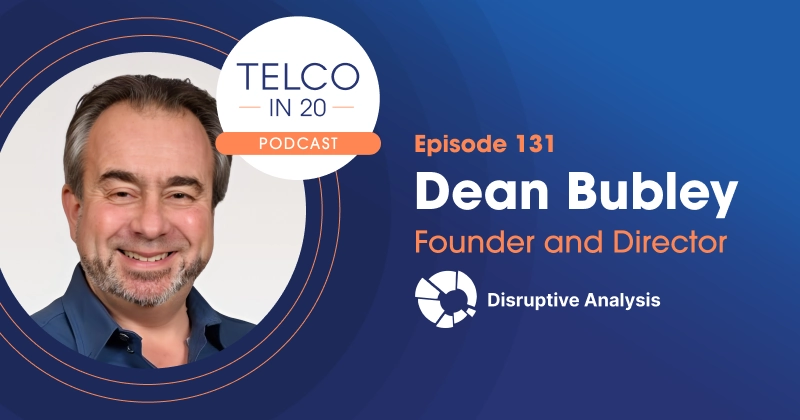
Ep 131 – Two takes on telco’s biggest bets for 2026 (Dean Bubley)
Dean Bubley and I dive into MWC26’s biggest themes and explore why operators are at risk of missing out on another major technology shift.
The telecommunications industry is heading to MWC Barcelona with a strong desire to skip AI hype in favor of AI proof. Telco executives aren’t looking for more possibilities—they’re demanding real deployments, measurable outcomes, and P&L impact.
For this episode, I’m joined by Rick Lievano, Microsoft’s CTO for the Worldwide Telecommunications Industry. We dive into Microsoft’s vision for network autonomy, real-world deployments delivering breakthrough results, and the barriers holding telcos back from deploying AI agents at scale.
Listen now to hear:
Wanna talk AI and public cloud? Telco execs, set up a meeting with our team to learn how to tap the immense business value it can bring.
Rick Lievano is Microsoft’s CTO for the Worldwide Telecommunications Industry. He works with customers and partners in developing telecommunications industry solutions and reference architectures to address the rapidly changing needs of service providers across the globe. He is an enthusiastic participant and speaker in many industry communities, an advocate of industry frameworks and open standards, and holds TM Forum Open Digital Architecture and Business Development Manager Career Certifications. At TM Forum, he is a member of the Composable IT & Ecosystems Mission, overseeing the effective creation and adoption of pragmatic best practices and standards to deliver value to the membership. As a board member at both Mplify Alliance (former MEF Forum) and Linux CAMARA, his contributions drive the industry toward a more connected and efficient digital future. Rick currently leads initiatives to help operators achieve more by infusing agentic artificial intelligence across their business in a secure and responsible manner.
The Telco in 20 podcast is ranked in the top 5% of all podcasts globally by Listen Notes! 🎉 We’ve also won 2024 and 2025 MarCom Awards, 2024 and 2025 Hermes Creative Awards, and are recognized as a TeckNexus Top 12 Telco and Tech Podcast, Forrester Top 100 Channel Podcast and Feedspot Top 10 Telecom Podcast.
If you enjoy the podcast, would you leave us a review? It takes you seconds to do in your app and it really makes a difference in helping to convince hard-to-get guests. And I love reading your feedback and reviews!
 Get my FREE newsletter, delivered every two weeks, with curated content to help telco execs across the globe move to the public cloud.
Set up a meeting with our team to learn how to tap the immense business value it can bring.

NetAI is Microsoft’s autonomous networking framework that powers Azure’s global network operations. It uses intelligent AI agents to handle network operations tasks like anomaly detection, diagnostics, and repairs. The framework delivers 40% more incident handling capacity, 80% faster root cause analysis, and 25% reduction in time to repair. NetAI is now available to telcos through Microsoft’s Network Operations Agent (NOA) Framework, enabling operators to build self-healing networks that operate at massive scale.
T-Mobile partnered with Microsoft Azure to unify its network data estate, processing nearly a petabyte daily and handling over a trillion transactions. It built an AI-driven autonomous network that responds instantly to outages like hurricanes. When cell towers go dark, surviving towers automatically re-tilt antennas, adjust power levels, and stretch coverage to fill gaps—without waiting for engineers. This ensures customers can make emergency calls and contact loved ones when communications matter most.
According to Rick Lievano, Microsoft’s CTO for the Worldwide Telecommunications Industry, the biggest roadblocks are weak AI governance and organizational readiness. IT executives are stopping AI agent deployments until they establish proper control mechanisms. The challenge isn’t building agents—it’s managing them at scale. Microsoft addresses this with Agent 365, which acts as an air traffic control tower for enterprise AI agents, providing centralized governance regardless of where agents originate.
Danielle Rios explains that Totogi’s approach focuses on using a telco-specific ontology as a foundation layer. Rather than having hundreds of agents each guessing what terms like “subscriber” or “churn risk” mean, the ontology establishes one canonical definition that every agent uses. This prevents AI hallucination through semantic consistency and serves as the operating model that tells agents which systems to access and with what constraints. Totogi will showcase BSS Magic and its telco ontology at MWC26 in Barcelona (Hall 2, March 2-5, 2026).
Sovereign data centers are built specifically for countries or regions requiring complete control over data jurisdiction. In Microsoft’s sovereign cloud model, all customer data stays within the region and is exclusively operated by in-region personnel. Microsoft announced three types: public sovereign cloud, private sovereign cloud, and national partner cloud. Bleu in France exemplifies this—Orange and Capgemini operate a sovereign Azure environment with zero Microsoft employee access, enabling telcos to run sensitive OSS/BSS and AI workloads under strict data residency guarantees.
SK Telecom partnered with Microsoft Foundry to build agentic AI workloads that rearchitect how customer interactions flow end-to-end. Rather than just plugging AI into single tasks like call centers, they’re creating multi-step, AI-driven experiences that function more like a digital lifestyle concierge than a traditional telco app. This represents SK Telecom’s evolution into a “techco” by building new AI-native digital experiences that leverage agentic AI capabilities, moving beyond the typical call-center implementations.