
Nail your AI architecture
The core problem: Telcos can use AI to free themselves from having to pay consultants for every change to their BSS/OSS systems. But will they? Most vendors are trying to maintain the status quo by pitching agentic AI with business logic baked in. The right architecture puts the business logic in an ontology: a structured, executable representation of operational semantics that every agent can reason against. It’s the only way to do enterprise-scale AI that gets you out of paying by the change.
How exciting is the promise of AI? I talk to telco CIO after CIO who can finally see a path out of paying for every single change to their BSS/OSS systems. They see a way to write their own systems and free themselves to move more quickly to support the business and subscribers.
But watch out. CIOs are about to repeat the same pattern that got them into the consulting trap in the first place—just with a layer of AI on top. The key is making the right architectural decisions.
What is a change request, anyway?
Let’s strip a telco change request down to the most basic work being done. There are six steps:
- Read the request in English.
- Figure out which systems need to change.
- Translate between the systems’ definitions of customer, product, and state.
- Write the code to bridge the gaps.
- Test the code.
- Document what was done (hopefully).
In 2020, a team of humans was required for each of those six steps. Now, with the capabilities of the frontier models improving every day, let’s look at the six steps in 2026:
- AI reads and comprehends English faster than humans.
- AI maps intent to APIs against a structured object model, if it has one.
- AI translates between fragmented systems instantly, if the architecture underneath lets it.
- AI generates the code at superhuman speed.
- AI tests the code at a scale no human team could match.
- AI writes the audit trail as it works.
Steps 1, 4, 5, and 6 are no longer interesting questions. Models comprehend English. Code generation, automated testing, and audit trails are a given. Any team building on modern AI infrastructure gets them for free.
Steps 2 and 3 are where the real work happens. Mapping to the right systems and translating between their fragmented definitions are the two things AI still needs help doing. The reason is structural: AI models reason over patterns in language, not over grounded truth about your business. Without an underlying structure that tells the model what your systems actually mean to each other, the model will hallucinate about your operations. Get this right, and the other four steps are easy. Get it wrong, and you’ll be back to needing humans for everything.
Getting it right
You may think the right move is building an agentic system—by putting your business logic into a series of agents. Most vendors in telco are pitching that today. Their agents understand their rules and their systems, so to the naked eye, it may seem like the right choice.
But it’s the wrong move.
Start with what an agent actually is. An agent is a reasoning capability. It takes inputs, applies logic, and produces outputs. It is not a knowledge store. When you put your business logic inside an agent, you’re conflating two different things: the reasoning that interprets a situation, and the knowledge that defines what your business actually is. Confuse those two, and every problem with agent-based architectures follows automatically.
Think about what putting business logic inside agents actually commits you to:
- Every agent you deploy contains business logic and rules.
- Every agent needs its own copy of every rule it touches.
- When a rule changes, you need to propagate it to every agent that holds it—or the agents drift apart.
- Agents reasoning about the same customer return different answers at runtime.
- Swapping one agent vendor for another means re-encoding all the rules that live inside the agent.
- The vendor that ships the agent owns the rules inside it—and charges you to change them.
Now do the math. You have four hundred BSS/OSS systems per telco. You’re likely going to deploy hundreds of agents. The coupling between agents and rules grows as a product, not a sum. Instead of freeing yourself from vendor lock-in, you’ll replicate it across every agent you deploy, multiplied by every rule you carry. You haven’t escaped the consulting bill. You’ve relocated it. You’ll have moved critical business knowledge from your applications into your agents—and added a new complication on top: the cost of keeping all your agents synchronized.
The answer: an ontology
The right architecture puts the business logic somewhere else: in an ontology. An ontology captures your operational logic—the rules and decisions that run your business—into a structure your agents can reason and act against.
Building something like this is not easy. The knowledge extraction is the real work, and it doesn’t happen overnight. Totogi is an AI-first software company, building the ontology for the industry to use, based on open standards from TM Forum. What you bring is your operational knowledge, business rules, and process. We work together to create your ontology. Once you have it, the architecture gives you:
- One copy of your business logic, used by every agent, regardless of creator.
- Agents that carry no operational knowledge of their own because they reason against the ontology.
- A single place to make changes, where every agent sees them immediately.
- Agents reasoning about the same customer return the same answer at runtime.
- The ability to swap agent vendors via a configuration change, not a re-implementation.
- Access to your own business logic, because it’s no longer trapped in vendor code and configurations.
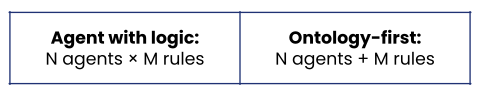
The structural difference is not subtle. In the first architecture, your business logic is duplicated across every agent that uses it. In the second, it lives once, in a layer you control. As you deploy more agents and capture more rules, the gap between those two numbers is the difference between an AI strategy that compounds in your favor and one that keeps you trapped, dependent on vendor consultants.
Once you have it captured, the value compounds. Changes are easy. Switching to new systems is trivial. You don’t need consultants anymore.
Zain Sudan deployed the Totogi Ontology to diagnose dormant cell sites. Detection-to-resolution dropped from 48 hours to 30 minutes. In the same loop, the ontology informed the network team about the cell, briefed customer support on what to say, alerted revenue forecasting to the issue, and reported to leadership what had happened—instantly, with no human in the loop coordinating. That’s the N + M architecture in action.
So, don’t put your business logic inside an agent. This approach puts you right back where you are now: not in control of the operational rules that run your business. Investing in your ontology future-proofs your systems for decades, enabling faster vendor swaps, faster business changes, and full leverage of AI.
This is the only way to do enterprise-scale AI.
You already own the deepest assets in enterprise software: networks, spectrum, trucks, last mile, and regulatory trust. The operational logic that runs on top of them sits in your consultants’ hands today. Use the Totogi Ontology to build the right AI architecture for your telco.
Recent Posts

 Get my FREE insider newsletter, delivered every two weeks, with curated content to help telco execs across the globe move to the public cloud.
Get started
Contact Totogi today to start your cloud and AI journey and achieve up to 80% lower TCO and 20% higher ARPU.

Discover
Before you invest in AI solutions, ask vendors this: Can you show me the money? Most can’t. But Totogi can. Watch DR’s talk to find out why.

Engage
Set up a meeting to learn how the Totogi platform can unify and supercharge your legacy systems, kickstarting your AI-first transition.

Dive deep
The Totogi Ontology sits atop your existing BSS, OSS, and network, providing the business context that enables AI to work across your entire estate.
Frequently Asked Questions
Because agents are reasoning engines, not knowledge stores. Confusing the two is exactly how you recreate the consulting trap with a fresh coat of AI paint. When you bake business logic into an agent, you now have N agents × M rules. Every agent that touches a rule holds its own copy. When a rule changes, you have to chase it across every agent that carries it, or your agents start giving different answers about the same customer. If you want to swap one vendor’s agent for another, you have to re-encode all the rules that live inside it. That’s not AI transformation. That’s vendor lock-in, multiplied.
A telco ontology is a structured, executable representation of your operational logic: the rules, relationships, and decisions that define how your business actually runs. Think of it as the single source of truth your AI agents reason against, rather than carrying that logic around inside themselves. Instead of N agents × M rules, you get N agents + M rules. Changes happen once, in the ontology, and every agent sees them instantly. Every agent reasoning about the same customer returns the same answer. That’s the math that actually gets you out of paying by the change.
Today, the operational logic that runs your business sits in your consultants’ hands—buried in vendor code, bespoke integrations, and the heads of people who’ve been there 20 years. Every change requires a human chain: 1) read the request, 2) figure out which systems need updating, 3) translate between their conflicting definitions, 4) write the code, 5) test it, and 6) document it. AI can now handle steps 1, 4, 5, and 6 for free. The only remaining hard problems are 2) mapping to the right systems and 3) translating between their fragmented definitions. That’s what an ontology solves. Without it, you still need humans—and consultants—for everything that matters.
Zain Sudan deployed the Totogi Ontology to diagnose dormant cell sites. Detection-to-resolution dropped from 48 hours to 30 minutes. In the same automated loop, the ontology briefed customer support on what to say, alerted revenue forecasting to the financial impact, informed the network team about the affected cell, and reported to leadership—all with no human coordinating any of it. That’s not a chatbot. That’s enterprise-scale AI that runs your operations end-to-end because every agent is reasoning against the same ground truth about your business.
Most vendors are pitching agentic AI with the business logic baked into their agents, which means the knowledge about how your business works stays locked inside their code, and they keep charging you to change it. It’s the same consulting trap, dressed up in a new acronym. The ontology-first approach is architecturally different: your business rules live in a layer you control, separate from any agent vendor. You can see your own logic. You can change it once and have every agent reflect it immediately. You can swap vendors via configuration, not re-implementation. Every time you add a new agent or capture a new rule, the value compounds—instead of multiplying your lock-in.