 Apple Podcasts
  Spotify
  YouTube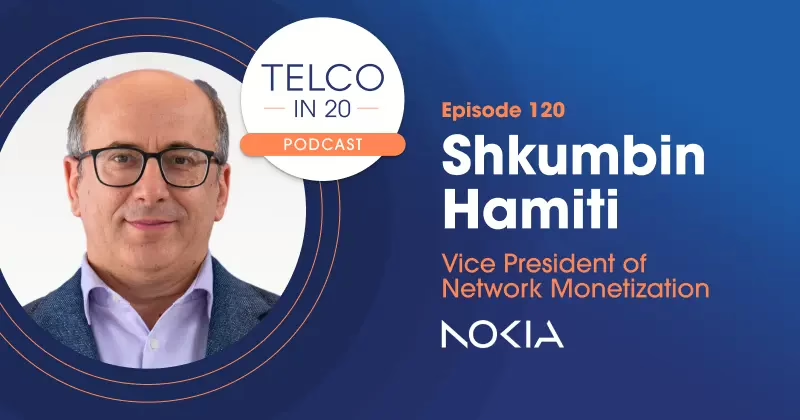
Ep 120 – The $300 billion question: Can telcos monetize network APIs? (Shkumbin Hamiti)
Nokia's Shkumbin Hamiti explains why building a developer community is crucial for telcos that want a piece of network APIs' $300 billion revenue potential.

Network APIs are the telecom industry’s next big bet for unlocking new revenue, with McKinsey & Company projecting they could generate up to $300 billion in connectivity and edge computing revenue over the next four to six years. But the real challenge isn’t technical—it’s convincing millions of developers to adopt telco’s network APIs instead of sticking with what they already use.
Google Cloud runs the largest private network on the planet, managing billions of users with a fraction of the staff that regional telcos need. Now it’s opening up its playbook to share this AI-driven approach with telecommunications operators.
In this episode, I’m talking with Angelo Libertucci, global head of industry for telecom at Google Cloud, about its partnership with Ericsson to build a cloud-native, 5G core and autonomous operations framework entirely on Google Cloud that can self-heal and self-optimize without human intervention.
Listen now to hear:
Wanna talk AI and public cloud? Telco execs, set up a meeting with our team to learn how to tap the immense business value it can bring.
Angelo Libertucci heads the telecom industry for Google Cloud globally. He is responsible for business development and strategy, partnerships, and field enablement that will drive CSP service differentiation and value, leveraging Google Cloud’s technology and platform. He also identifies and capitalizes on new opportunities across Google’s ecosystem.
The Telco in 20 podcast is ranked in the top 5% of all podcasts globally by Listen Notes! 🎉 We’ve also won a 2024 MarComm Award, 2024 and 2025 Hermes Awards, and are recognized as a TeckNexus Top 12 Telco and Tech Podcast, Forrester Top 100 Channel Podcast and Feedspot Top 10 Telecom Podcast.
If you enjoy the podcast, would you leave us a review? It takes you seconds to do in your app and it really makes a difference in helping to convince hard-to-get guests. And I love reading your feedback and reviews!
 Get my FREE newsletter, delivered every two weeks, with curated content to help telco execs across the globe move to the public cloud.
Set up a meeting with our team to learn how to tap the immense business value it can bring.

Google Cloud and Ericsson partnered to create a carrier-grade, cloud-native 5G core stack that runs entirely on Google Cloud infrastructure. This platform allows telcos to deploy services instantly, narrowing the gap between cost and revenue while eliminating the need for traditional hardware over-provisioning. The timing is now ideal because Google Cloud has significantly expanded its distributed infrastructure globally. For example, Canada went from having one region six years ago to two regions today, meeting the stringent latency and performance requirements that 5G networks demand.
When AI is natively integrated into the network core, it shifts operations from manual configuration and reactive troubleshooting to a system that constantly learns and self-optimizes. This enables autonomous networking capabilities where networks can self-heal and adapt without human intervention. Google Cloud builds AI across all its platforms and products, with the goal of enabling AI-driven telecom operations. Without AI natively integrated into cloud-native workflows, telcos cannot achieve the level of autonomous networking that’s becoming today’s killer use case.
Total-cost-of-ownership reduction comes from several areas: lower OpEx through increased automation, faster time-to-market for new services affecting revenue, and the ability to dynamically adapt to market demand without over-provisioning hardware. According to Angelo Libertucci, if network utilization is below 50%, running in the cloud is typically cheaper. Since most telcos run networks at only 30-33% utilization to avoid performance issues during spikes, the financial modeling with customers shows promising results for cloud migration.
No, telcos can gain immediate value without moving network workloads to the cloud first. Google Cloud’s autonomous networking framework allows operators to keep network functions on-premise while building data pipelines to the cloud for AI-driven analytics. Bell Canada demonstrated this approach with its wireless network AIOps program, achieving a 25% reduction in customer calls, 75% reduction in network alarms, and 75% increase in software productivity—all within months and without moving on-premise network functions to the cloud.
Danielle Rios, the acting CEO of Totogi, has been advocating for telcos to move their networks to the public cloud for years, making this partnership a significant milestone she’s been championing. She emphasizes that this isn’t a traditional lift-and-shift migration, but rather a fundamental transformation where AI doesn’t just monitor networks—it actually runs them. She recommends telcos start with an analytics wedge approach to build organizational confidence before making larger commitments, and encourages telco executives to connect with Totogi to explore public cloud opportunities.
Google Spanner serves as the foundation for autonomous networking by maintaining a comprehensive real-time digital twin of the network that mirrors inventory, topology, services, and state. It’s uniquely capable of supporting both graph and relational data, providing a multilayered view of network layers including services, physical, and logical components. When combined with BigQuery for data analysis and Gemini for AI processing, Spanner enables the level four and level five network autonomy that telcos need. This is why Danielle Rios was advocating for Spanner’s use in telecom back in 2018.