
 Apple Podcasts
  Spotify
  YouTube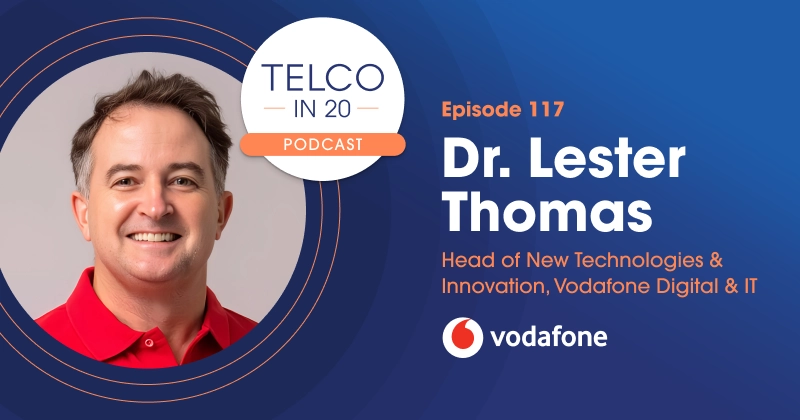
Ep 117 – Vodafone’s new rules with open APIs, cloud-native, and AI (Lester Thomas)
Dr. Lester Thomas explains how Vodafone is leveraging TM Forum standards and building a modular, AI-ready technology foundation.
Telecom operators worldwide need to modernize their infrastructure and reduce costs. While many have been hesitant to move critical network functions to the public cloud, a growing number of visionary operators are proving that cloud-native networks aren’t just possible—they’re the future.
Today, I’m speaking with Mallik Rao, chief technology and enterprise business officer at Telefónica Germany, who is leading the world’s first brownfield migration of a 5G core network to AWS. We dive into the technical challenges his team faced, the organizational transformation required, and why combining cloud-native architecture with Open RAN is poised to revolutionize how telcos operate.
Listen now to hear:
Wanna talk AI and public cloud? Telco execs, set up a meeting with our team to learn how to tap the immense business value it can bring.
Mallik Rao has been a member of the Management Board of Telefónica Deutschland Holding AG since the end of October 2019. He was initially responsible for the mobile and fixed network as well as the IT of Telefónica Deutschland in his role as chief technology & information officer. Mallik Rao has also been assigned responsibility for the business customer division and the company’s data platforms and artificial intelligence activities in his role as chief technology & enterprise officer. Mallik has more than 25 years of experience in the international telecommunications industry. He lived and worked in seven countries, bringing experience from technology providers like Ericsson and Nortel, and service providers like Vodafone and Aircel. He is passionate about working with various cultures and building technology solutions for customers.
The Telco in 20 podcast is ranked in the top 5% of all podcasts globally by Listen Notes! 🎉 We’ve also won a 2024 MarComm Award, a 2024 and 2025 Hermes Award, and are recognized as a TeckNexus Top 12 Telco and Tech Podcast, Forrester Top 100 Channel Podcast and Feedspot Top 10 Telecom Podcast.
If you enjoy the podcast, would you leave us a review? It takes you seconds to do in your app and it really makes a difference in helping to convince hard-to-get guests. And I love reading your feedback and reviews!
 Get my FREE newsletter, delivered every two weeks, with curated content to help telco execs across the globe move to the public cloud.
Set up a meeting with our team to learn how to tap the immense business value it can bring.

Telefónica Germany became the world’s first brownfield mobile operator to fully migrate its 5G core network to the public cloud using AWS infrastructure and Nokia’s cloud-native core. Unlike DISH’s greenfield deployment, this represents the first successful migration of an existing operational network to the public cloud, proving that legacy operators can modernize their infrastructure. The company has already moved more than 1.2 million 5G subscribers in six months and plans to migrate 30-40% of its customer base by 2026.
After 18 months working with Ericsson and AWS, Mallik Rao killed the initial program because success wasn’t just about technology—it required all partners to truly collaborate with aligned interests. The key learning was that telecom workloads fundamentally behave differently than IT workloads. While IT applications must adapt to cloud infrastructure, telecom software dictates how the hardware should behave, requiring AWS to completely redesign its infrastructure specifically for network-intensive telecom applications. Learn more about how the operator shifted from Ericsson to AWS and Nokia.
AWS Outpost 2.0 is a redesigned hardware infrastructure specifically engineered for telecom workloads. Unlike IT applications that need compute and storage intensity, telecom requires network-intensive capabilities with significantly higher transactions per second. AWS had to completely redesign the backplane architecture—focusing on layer 2 and layer 3 networking rather than just compute and storage—to handle the unique demands of telecom software and achieve the necessary performance for carrier-grade networks.
The biggest advantage is time-to-market improvement—Telefónica Germany can deploy infrastructure and software twice as fast as on-premise solutions. Total cost of operation becomes equal or better than traditional infrastructure, but only when deployed at scale (at least 20-25% of workload). Previously, software upgrades took months; now they can be done in hours. However, achieving these benefits requires deploying at scale and fully embracing cloud-native practices like auto-scaling and elasticity.
Totogi offers Charging-as-a-Service, which embodies true cloud-native design with multi-tenant architecture, automatic scaling, and usage-based pricing. The platform can handle one billion subscribers on a single charger with continent-level support and CI/CD-driven upgrades. This aligns with Rao’s emphasis that telecom software providers must implement auto-scaling capabilities to truly leverage public cloud advantages, rather than simply lifting-and-shifting traditional architectures to cloud infrastructure.
Telefónica’s primary goal with Open RAN is disaggregating hardware and software lifecycles in the radio access network. Software updates occur 30 times more frequently than hardware replacements, yet traditional vendors force hardware upgrades for software features. By separating these lifecycles, operators can innovate at software speed rather than hardware speed, potentially reducing total cost of ownership by up to 50% while maintaining flexibility to work with multiple vendors like Samsung, Ericsson, or Nokia.