 Apple Podcasts
  Spotify
  YouTube
Ep 122 – Microsoft’s hypervelocity engineering for hypervelocity telcos (Robin Cole)
Discover how AT&T and KT Corporation use Microsoft's hypervelocity engineering to build AI solutions in weeks instead of months.
Telco transformation projects are legendary for their complexity. Operators must maintain 99.999% uptime while ripping out decades-old legacy systems that are deeply intertwined with every aspect of their business. They involve massive technical debt, vendor lock-in, regulatory compliance requirements, and the challenge of modernizing infrastructure—all of which need to be managed while serving millions of customers who expect flawless service. Add in organizational resistance to change, budget constraints, and the fact that many telcos still run critical systems on 1980s mainframes, and you have a perfect storm. Getting it wrong can mean network outages, customer churn, regulatory fines, and revenue loss that can run into the hundreds of millions.
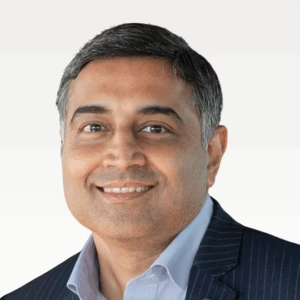
In this episode, I’m talking with Amol Phadke, Chief Transformation Officer at Tech Mahindra. With over 25 years of experience spanning Google Cloud, Telenor, and now leading AI transformation at a major service provider, Amol has seen transformation from every angle. We explore why traditional projects fail, how successful telcos are building new revenue streams, and Tech Mahindra’s framework for AI-driven transformation.
Listen now to hear:
Wanna talk AI and public cloud? Telco execs, set up a meeting with our team to learn how to tap the immense business value it can bring.
Amol Phadke is a senior business executive providing leadership in AI, cloud, software networks and IT, Big Tech, and telecommunications. He specializes in strategy definition, execution of large-scale engineering and innovation development/delivery units, and leading global multi-discipline teams. He is Chief Transformation Officer at Tech Mahindra, where he supports the CEO on strategic initiatives across the company, including elevating the communications industry vertical globally. Prior to Tech Mahindra, Amol served as EVP and Group CTO at Telenor Group, and as a member of Telenor’s group executive management team. Prior to Telenor, Amol was served as Global GM for the communications service provider industry vertical at Google Cloud.
The Telco in 20 podcast is ranked in the top 5% of all podcasts globally by Listen Notes! 🎉 We’ve also won a 2024 MarComm Award, 2024 and 2025 Hermes Awards, and are recognized as a TeckNexus Top 12 Telco and Tech Podcast, Forrester Top 100 Channel Podcast and Feedspot Top 10 Telecom Podcast.
If you enjoy the podcast, would you leave us a review? It takes you seconds to do in your app and it really makes a difference in helping to convince hard-to-get guests. And I love reading your feedback and reviews!
 Get my FREE newsletter, delivered every two weeks, with curated content to help telco execs across the globe move to the public cloud.
Set up a meeting with our team to learn how to tap the immense business value it can bring.

Telco transformation projects face a “perfect storm” of challenges. Operators must maintain 99.999% uptime while replacing decades-old legacy systems deeply integrated throughout their business. They struggle with declining revenues, increased customer expectations, and rising infrastructure costs—sometimes reaching a point where return on invested capital falls below their weighted average cost of capital. Additionally, brownfield environments, vendor lock-ins, and massive technical debt (including critical systems from the 1980s) make radical transformation extremely difficult. The scale alone—thousands of applications and hundreds of legacy systems—creates complexity that can destroy executive careers and budgets.
Tech Mahindra’s six-pillar AI transformation framework includes: (1) Value—clearly articulating AI’s impact on revenue, cost, or customer experience; (2) Data—integrating data seamlessly so AI can use it effectively; (3) Architecture & Ecosystem—building the right AI infrastructure, including Tech Mahindra’s Orion platform for agentic AI; (4) Responsible AI—preventing hallucinations and ensuring models work correctly; (5) Upskilling—training entire enterprises on AI, not just select teams; and (6) Innovation—continuous experimentation through initiatives like Tech Mahindra’s Makers Lab to keep pace with rapid AI advancements.
Successful telcos leverage their position as trusted parties to build sovereignty and resilience infrastructure, creating new revenue opportunities. They recognize that AI cannot function without underlying network infrastructure—whether fiber, 5G, or 6G—positioning themselves as essential to what Amol Phadke calls a “connected intelligence ecosystem.” Rather than focusing solely on cost transformation, winning telcos combine connectivity with AI-powered intelligence to move up the value chain, offering services that capitalize on their unique infrastructure advantages and trusted relationships with governments and customers. Dr. Lester Thomas from Vodafone discusses similar transformation challenges in his Telco in 20 episode.
DR argues that to see real financial impact from AI, telcos must actually replace human work with AI, not just augment teams or make them 20% more productive. While telcos deploy AI-powered network optimization, predictive maintenance, and chatbots, some CEOs report seeing AI “everywhere except in my P&L.” Since growing revenue requires customer demand (not fully controllable), cutting costs through AI-driven workforce replacement is 1,000% in leadership’s control. DR emphasizes this doesn’t threaten humanity—the World Economic Forum projects AI will eliminate 92 million jobs but create 170 million new ones.
BSS Magic is a game-changer for telco transformation, particularly when migrating data to new systems. Unlike traditional approaches that require iterative attempts to get data migration right, BSS Magic allows operators to work directly inside the platform and complete the job in 20% of the time. This dramatically reduces the timeline and risks associated with BSS transformation projects, which are notoriously complex and prone to failure. The platform eliminates the trial-and-error approach that typically extends transformation timelines and budgets. Want to see it in action? Book a demo!
According to Amol Phadke, the AI and agentic era is fundamentally changing the service provider model. Historically, providers offered services to help make software run better—evolving from mainframes, to purpose-built software, to SaaS. Now, with AI agents (which are essentially code), Tech Mahindra’s offerings embed software directly into services, making “service as a software” the new paradigm. This shift changes everything from procurement (one team now handles both services and software) to commercial models (introducing concepts like tokenization and service tokens), representing a fundamental transformation in how professional services companies operate.