 Apple Podcasts
  Spotify
  YouTube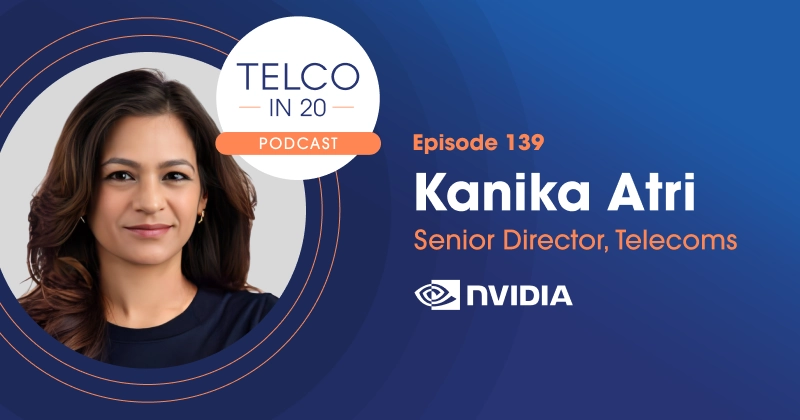
Ep 139 – Can telco build an AI grid? (NVIDIA’s Kanika Atri)
Telcos are turning network infrastructure into distributed AI compute platforms, while the software layer remains the industry’s biggest unanswered question.
Anthropic’s latest model, Mythos, recently scored 94% on a benchmark for solving real software engineering problems—up from single digits just two and a half years ago. It also found a 27-year-old security flaw in OpenBSD that decades of human testing missed. AI’s capabilities are exploding, and many operators are struggling to keep up.
For this episode, I’m talking with Roy Chua, founder and principal of AvidThink, an independent analyst firm that advises everyone from Silicon Valley startups to the world’s largest telcos. We dive into the growing gap between how startups and telcos are adopting AI, what happens to the $50 billion professional services industry when AI can write telco software, and why agents need an ontology layer to actually deliver.
Listen now to hear:
Wanna talk AI and public cloud? Telco execs, set up a meeting with our team to learn how to tap the immense business value it can bring.
Roy Chua, an entrepreneurial executive with 20+ years of IT experience, is the founder of AvidThink, an independent analyst firm covering infrastructure technologies at both carriers and enterprises. AvidThink’s clients include Fortune 500 technology firms, early-stage startups, and upstart unicorns. Roy has been quoted by, and featured in, major publications including the Wall Street Journal, FierceTelecom/Wireless, The New Stack, and Light Reading. He is a graduate of MIT Sloan (MBA) and UC Berkeley (BS, MS EECS).
The Telco in 20 podcast is ranked in the top 5% of all podcasts globally by Listen Notes! 🎉 We’ve also won 2026, 2025, and 2024 Hermes Creative Awards, 2025 and 2024 MarCom Awards, and are recognized as a TeckNexus Top 12 Telco and Tech Podcast, Forrester Top 100 Channel Podcast, and Feedspot Top 10 Telecom Podcast.
If you enjoy the podcast, would you leave us a review? It takes you seconds to do in your app and it really makes a difference in helping to convince hard-to-get guests. And I love reading your feedback and reviews!
 Get my FREE newsletter, delivered every two weeks, with curated content to help telco execs across the globe move to the public cloud.
Set up a meeting with our team to learn how to tap the immense business value it can bring.

Mythos is Anthropic’s latest AI model, and it just scored 94% on the SWE-verified benchmark for solving real software engineering problems, up from single digits just two and a half years ago. What caught Roy Chua’s attention wasn’t just the score. Mythos uncovered a 27-year-old security bug in OpenBSD that decades of human testing had missed. For telcos still running hardened legacy code, this is a warning and an opportunity.
Leading startups have scrapped traditional coding interviews entirely. Instead, they give candidates access to any tool they want, hand them a problem too big to solve without AI, and watch how they work. Roy Chua sees this as the new standard, one that most telcos haven’t caught up to yet. In fact, some operators are still flagging AI use in interviews as cheating rather than recognizing it as the core skill.
Yes, but Roy Chua noted that Indian IT firms are still growing revenue, partly by pivoting to AI transformation services. That said, Nifty IT stocks have dropped roughly 20%, signaling that markets expect disruption ahead. Bulk coding, basic QA, and hand-written adapters are the most exposed and those make up a significant share of OSS/BSS work in telco today.
Without an ontology layer, agents operating in a live telco environment have no domain context—no understanding of equipment constraints, operational processes, compliance rules, or business logic. They’re essentially guessing. The Totogi Ontology solves this by sitting between underlying telco systems and the agentic layer, translating network data into something AI can reason with and restricting write actions to what makes sense in the operator’s environment.
DR sent her son through Gauntlet AI, a 10-week intensive program in Austin focused on mastering agentic AI. He’s doing another round this summer. With data from the Stanford Digital Economy Lab showing software development employment for 22- to 25-year-olds down 20% from a 2022 peak, and computer science graduate unemployment at 6.1%, she’s direct: the curriculum matters less than building hands-on AI skills outside the classroom.
Move 37 refers to the unexpected, game-changing play—the one no one sees coming until it’s already happened. DR’s take is that the real move isn’t just AI optimizing the network. It’s AI rewriting the entire software layer with full business understanding, enabling better decisions and helping leaders build a fundamentally different telco. Roy Chua agrees the software rewrite is inevitable. The truly surprising move is still ahead.