
 Apple Podcasts
  Spotify
  YouTube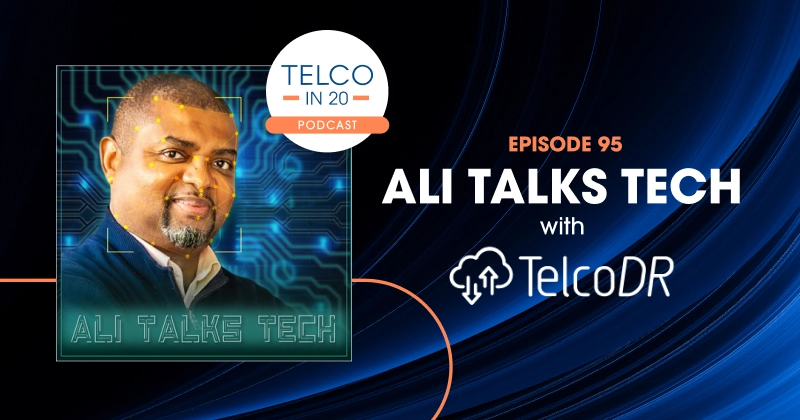
Ep 95 – African telcos: forge a new path!
Ali Talks Tech podcast host Ali Hussein Kassim and I explore how African telcos can capitalize on using the public cloud with older networks, how AI is poised to drive real change on the continent, and more.
From streamlining network operations to boosting customer experiences, artificial intelligence (AI) is helping trailblazing telcos stay competitive in a rapidly changing landscape.
For this episode, I explore Canadian telco TELUS’ AI transformation with its Chief Insights Officer, Jaime Tatis. We talk about how the operator is already using AI to reduce costs, increase efficiency, and get its workforce ready for the future. Listen now to hear:
Wanna talk public cloud? Telco execs, set up a meeting with our team to learn how to tap the immense business value it can bring.
Jaime Tatis, the Chief Insights & Analytics Officer at TELUS, spearheads the evolution of data, AI, and analytics strategy across the TELUS ecosystem. With a keen focus on fostering a culture of innovation, Jaime drives the company’s transformation towards pioneering customer technology solutions. Leveraging data-driven insights and cutting-edge cloud-based infrastructure, Jaime empowers TELUS with state-of-the-art Artificial Intelligence and Machine Learning capabilities. Through this strategic approach, Jaime elevates business performance, enhances operational efficiency, and delivers unparalleled customer experiences, positioning TELUS at the forefront of technological innovation.
The Telco in 20 podcast won 2024 and 2022 Hermes Awards, 2023 and 2022 MarComm Awards, and was recognized as a TeckNexus Top 12 Telco and Tech Podcast, Forrester Top 100 Channel Podcast and Feedspot Top 10 Telecom Podcast. If you enjoy the podcast, would you leave us a short review? It takes you seconds to do in your app and it really makes a difference in helping to convince hard-to-get guests. And I love reading your feedback and reviews!
 Get my FREE newsletter, delivered every two weeks, with curated content to help telco execs across the globe move to the public cloud.
Set up a meeting with our team to learn how to tap the immense business value it can bring.

Fuel iX is TELUS’s enterprise-grade AI engine launched in 2024 to help companies upgrade their GenAI pilots to production scale in a safe and secure manner. The platform taps into more than 100 LLMs and is used internally by TELUS team members (around 35,000 daily users) and offered to enterprise customers. Internally, employees use it for optimizing models, writing code, generating images, and analyzing complex reports. One standout application is the internal IT support system, which has handled over 70,000 chats and increased self-serve resolution by 49%, enabling 25% cost savings in just 12 months.
According to Jaime Tatis, building specialized telco-specific LLMs may not be necessary at this stage. While some operators like SK Telecom have invested over $100 million in developing telco-specific models with Anthropic, Tatis believes developing and maintaining industry-specific LLMs is extremely costly and resource-intensive, with ROI that may not justify the spend. Instead, TELUS focuses on adapting existing general-purpose models that can be fine-tuned with specific datasets to meet telco needs without building from scratch. As Danielle Rios from TelcoDR notes, the rapid advancement of AI technology makes flexibility in choosing LLMs essential.
TELUS partnered with Google Cloud in 2020 to radically transform its data infrastructure rather than simply lifting and shifting legacy systems. The company deprecated over 30% of obsolete datasets from what it called its “data swamp,” built new data pipelines using modern SRE principles, and consolidated everything into a single enterprise data hub with strong privacy and security by design. This transformation broke down data silos and democratized access to curated information across the organization. Read more about how TELUS worked with Google Cloud and Accenture to modernize its data stack and create AI-ready foundations.
TELUS created and won awards for the Neo Assistant, an AI-powered solution that significantly improved network technician efficiency. Using machine learning, it enhanced forecasting accuracy for network events from 69% to 89%, helping technicians work smarter and make the right fix the first time. The GenAI-powered device-accessible solution guides technicians through tasks, achieving 75% adoption by field workers. Combined with other AI solutions, TELUS reduced network operating costs by over $20 million (some reports cite $15 million specifically for network operations). For more inspiration on AI applications, check out DR’s blog about 10 examples of how telcos are using AI.
TELUS developed an AI-powered translation copilot to help team members communicate in both French and English, Canada’s official languages. The tool was trained to understand company-specific lingo and tone, achieving an 87.5% accuracy rate compared to professional human translators in blind testing. Beyond matching quality, the solution provides instantaneous translation rather than the multi-day turnaround required for professional services, dramatically accelerating business communications. This demonstrates how TELUS’s commitment to responsible data practices enables AI applications that deliver immediate business value.
As DR emphasizes in her Telco in 20 takeaway, making AI work depends entirely on data quality. Many telcos sit on siloed, obsolete information trapped in legacy vendors’ databases. It isn’t clean or structured enough for AI applications. You can’t just lift and shift that data to the public cloud and expect miracles—radical data transformation is required. TELUS’s experience shows that while this transformation takes time and effort (along with hyperscaler support), the payoff is huge. If you’re ready to transform your data infrastructure for AI success, set up a meeting with TelcoDR or reach out to DR on LinkedIn or X @TelcoDR.