
 Apple Podcasts
  Spotify
  YouTube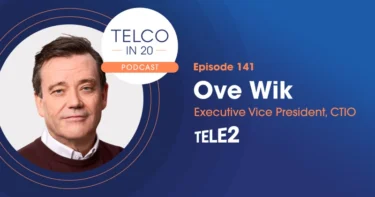
Ep 141 – Tele2 goes back to the future (Ove Wik)
Tele2 EVP and CTIO Ove Wik explains how Sweden’s original challenger brand is going “back to the future” and using AI to reclaim the customer relationship.
Every major telco is racing to claim a piece of the AI infrastructure stack. Operators like Telefónica, Orange, Deutsche Telekom, SoftBank, and TELUS are betting on sovereign clouds, AI factories, and GPU-as-a-service to deliver local data, national compute, and a seat at the AI table.
Then there’s AT&T. In March, it announced AWS Interconnect – last mile: fiber and fixed wireless plugged directly into AWS and engineered for AI workloads. AT&T’s view is that enterprises using AI don’t just need more compute—they need flatter networks and faster connections. So it’s betting on the layer it owns outright—the last mile.
In this episode, I’m joined by Shawn Hakl, SVP of product at AT&T Business. We dig into why the operator is partnering with hyperscalers instead of competing with them, the use case where AT&T deployed AI at the edge to cut latency from 110ms to 40ms, and what an “agent-consumable” network actually looks like.
Listen now to hear:
Wanna talk AI and public cloud? Telco execs, set up a meeting with our team to learn how to tap the immense business value it can bring.
As the senior vice president of product at AT&T Business, Shawn Hakl is responsible for the portfolio servicing enterprise, public sector, partner, and small business segments, which generates over $30 billion in annual revenue. A seasoned leader in cloud, AI, and communications, Shawn’s unique knowledge of software, security, and infrastructure is helping enterprises, government, and small businesses harness the power of technology to successfully execute on their digital transformation. In his current role, Shawn is responsible for wireline, 5G/wireless, voice/UC, security/SASE, data center, AIOps, and Network-as-a-Service product lines.
The Telco in 20 podcast is ranked in the top 5% of all podcasts globally by Listen Notes! 🎉 We’ve also won 2026, 2025, and 2024 Hermes Creative Awards, 2025 and 2024 MarCom Awards, and are recognized as a TeckNexus Top 12 Telco and Tech Podcast, Forrester Top 100 Channel Podcast, and Feedspot Top 10 Telecom Podcast.
If you enjoy the podcast, would you leave us a review? It takes you seconds to do in your app and it really makes a difference in helping to convince hard-to-get guests. And I love reading your feedback and reviews!
 Get my FREE newsletter, delivered every two weeks, with curated content to help telco execs across the globe move to the public cloud.
Set up a meeting with our team to learn how to tap the immense business value it can bring.

AT&T sees hyperscalers as natural partners, not competitors. As Shawn Hakl explains, AT&T has more endpoints than anyone—it’s the origination point of every transaction, while the hyperscalers are the destination. Rather than investing in GPU infrastructure, AT&T is doubling down on what only it can do: provide the flattest, fastest, most secure path from the network edge into the cloud. The AWS Interconnect – last mile announcement is the clearest expression of that strategy.
AWS Interconnect – last mile connects AT&T’s fiber and fixed wireless directly to AWS environments, letting enterprises manage the network as a resource inside their Amazon instance. For AI workloads, this matters because agentic applications require extremely low latency. Traditional cloud apps were built for 25–30 millisecond round trips, but multi-agent interactions can demand 5–7 milliseconds. A harmonized, managed path from the network edge to the cloud removes a critical bottleneck.
Working with Cisco and NVIDIA, AT&T connected the radio access network edge directly to GPU-as-a-service infrastructure at the edge. In a live deployment with TanMar, running AI across roughly 100 cameras in five states, response latency dropped from 110ms to 40ms. The use case was video processing: license plate and facial recognition where real-time decision-making is essential. Not every workload benefits from edge AI, but for latency-sensitive applications, the results are significant.
As DR highlighted in the episode takeaway, an agent-consumable network needs to be discoverable (agents can find what they need without being told), predictable (agents get consistent responses), and programmatic (agents never have to leave their own workflow). Shawn Hakl describes it as building layered interfaces exposed through established developer ecosystems, with zero-trust security throughout. Agents can discover, access, and act on network resources without human intervention.
As AI agents multiply across enterprise environments, they need shared business context to act consistently and correctly. Without it, agents misinterpret data, duplicate effort, or take conflicting actions. The Totogi Ontology gives AI the structured business context it needs to discover services, understand relationships, and execute reliably—exactly the kind of foundation Danielle Rios emphasizes when she talks about building networks and systems that agents can actually consume.
AT&T’s internal Ask AT&T platform has scaled to more than 100,000 users consuming 27 billion tokens a day, with nearly 1.8 billion daily transactions running in production environments. Teams are now building custom AI agents using a drag-and-drop tool. Shawn Hakl’s point is that AT&T isn’t just selling AI solutions to enterprises. It’s running on them. That real-world experience informs how AT&T advises customers on their own AI deployments.