
 Apple Podcasts
  Spotify
  YouTube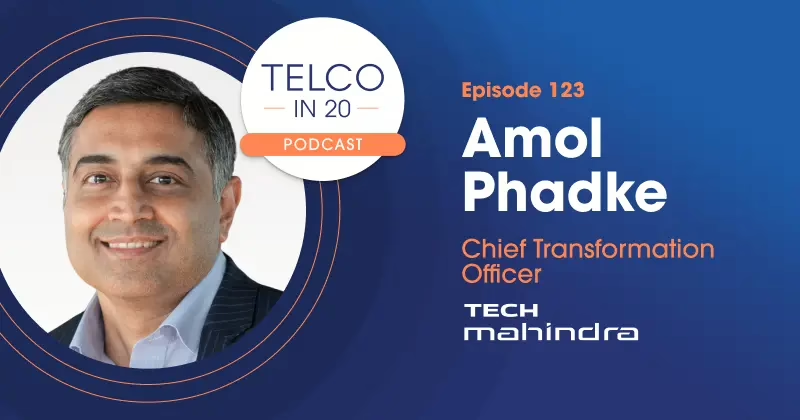
Ep 123 – Talking telco transformation with Tech Mahindra (Amol Phadke)
Amol Phadke from Tech Mahindra explains why telco transformations fail and shares a six-pillar AI framework for driving real business value.
MVNOs are having their moment. From Ryan Reynolds with Mint Mobile to the Trumps launching Trump Mobile, everyone wants in.
But the truth is it’s tough to be an MVNO. MVNOs who pay millions in licensing fees struggle to actually go live because incumbent MNOs work overtime to squash them. Take Nigeria – regulators handed out 46 MVNx licenses and collected serious cash from hopeful startups. The result? Zero MVNOs have successfully launched to date.
In this episode, I’m talking with Allan Rasmussen, CEO of MVNO Services and one of the world’s leading MVNO strategists. He has witnessed hundreds of MVNO dreams crash and burn while also guiding success stories that cracked the code. We dive deep into the regulatory challenges facing MVNOs worldwide and Allan’s strategies for navigating the chaos.
Listen now to hear:
Wanna talk AI and public cloud? Telco execs, set up a meeting with our team to learn how to tap the immense business value it can bring.
Allan Rasmussen is an MVNA/MVNE/MVNO specialist with hands-on experience from more than 60 projects in both competitive and greenfield markets. His expertise includes business case development, execution, launch, and growth strategies. He is an advisor and consultant to MNOs, MVNAs, MVNEs, MVNOs, national regulatory authorities, government agencies, TMT industry associations, and innovation and investment banks. Allan is a well-known voice in the global MVNO space as a walking MVNO wiki, and is recognized for his expertise in spotting emerging trends and curating crucial industry news. He brings a unique blend of strategic foresight and practical experience to his work, all while championing his core values of fostering MVNO growth and sharing knowledge.
The Telco in 20 podcast is ranked in the top 5% of all podcasts globally by Listen Notes! 🎉 We’ve also won a 2024 MarComm Award, 2024 and 2025 Hermes Awards, and are recognized as a TeckNexus Top 12 Telco and Tech Podcast, Forrester Top 100 Channel Podcast and Feedspot Top 10 Telecom Podcast.
If you enjoy the podcast, would you leave us a review? It takes you seconds to do in your app and it really makes a difference in helping to convince hard-to-get guests. And I love reading your feedback and reviews!
 Get my FREE newsletter, delivered every two weeks, with curated content to help telco execs across the globe move to the public cloud.
Set up a meeting with our team to learn how to tap the immense business value it can bring.

Despite the Nigerian Communications Commission issuing 46 MVNX licenses and creating a regulatory framework, incumbent MNOs (MTN, Globacom, Airtel, and 9Mobile) are blocking MVNO launches by citing capacity issues while simultaneously advertising for more direct subscribers. This creates a classic regulatory standoff where the framework looks good on paper, but commercial negotiations fail in practice. The NCC risks losing credibility and faces financial pressure due to naira devaluation, making refunds nearly impossible and forcing them to eventually compel MNO cooperation through fines or spectrum licensing restrictions.
Allan Rasmussen advises MVNOs to double down on their business plans, refine their market niches beyond just pricing competition, and form alliances or associations to amplify their collective voice. MVNOs should attend industry events, engage the press, and maintain pressure on both the NCC and MNOs. This approach mirrors successful MVNO strategies globally, where the first movers pushed forward despite regulatory uncertainty instead of waiting for perfect conditions.
Canada struggles after its regulator CRTC changed its MVNO definition to require network infrastructure, contradicting the “virtual” concept. India has frameworks that look promising on paper but don’t function in practice. Pakistan previously charged $5 million for MVNO licenses and still has contradictory requirements in its new framework. Thailand represents the worst case, where the regulator auctioned the only spectrum MVNOs were using, forcing all MVNOs to cease operations and creating a duopoly. Learn more about Thailand’s MVNO collapse and Pakistan’s new framework.
Rather than fighting MVNOs, MNOs should become platforms that power MVNO innovation. Solutions like Totogi’s Wholesale Solution enable MNOs to sell their entire tech stack—BSS, AI-powered personalization, and multi-tenant architecture—to MVNOs. This transforms MVNOs from competitive threats to locked-in customers who purchase both network access and software, while providing MNOs with valuable subscriber insights across multiple brands. MVNOs create new markets rather than steal existing customers, ultimately driving overall usage and revenue growth.
DR uses “innovation inertia” to describe how MNOs resist change despite claiming to want competition. Nigerian MNOs exemplify this by advertising for more subscribers while claiming they lack capacity for MVNOs—exposing that the real issue isn’t network limitations but protecting oligopoly pricing. This inertia causes MNOs to miss the opportunity that Nigeria’s 46 licensed MVNOs represent: 46 different experiments in customer acquisition, pricing models, and service delivery that could provide valuable market research and drive industry innovation.
MTN recently announced significant infrastructure investments and a pivot toward “network as a service,” indicating readiness to onboard both MVNOs and other MNOs onto its network—similar to its South African strategy. Allan Rasmussen suggests MTN may have strategically appeared disinterested while secretly building this capability, since operators typically need one to two years to execute new strategies. This platform approach could position MTN to monetize MVNO partnerships more effectively than traditional wholesale agreements, making it a first mover in Nigeria’s MVNO market.