
 Apple Podcasts
  Spotify
  YouTube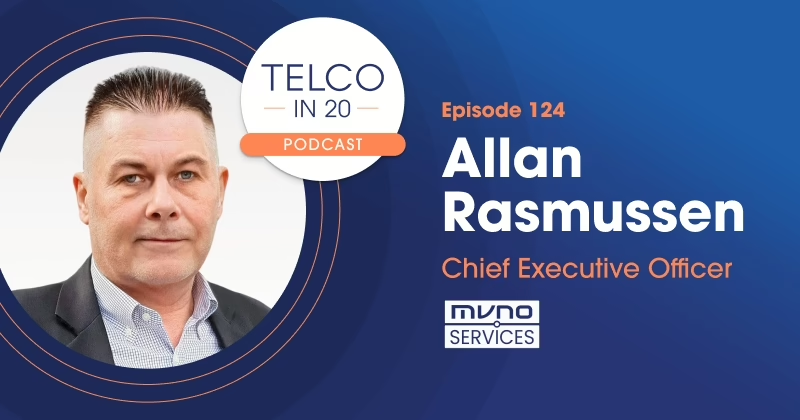
Ep 124 – The innovation inertia of MVNOs (Allan Rasmussen)
Allan Rasmussen, CEO of MVNO Services, discusses global MVNO licensing challenges, why Nigeria's market remains stalled, and opportunities on the horizon.
MIT research shows that 95% of enterprise AI projects fail, and the culprit is likely the daunting task of managing business context. When AI doesn’t understand the full picture of your business, it makes poor decisions and delivers disappointing results that leave operators questioning whether AI can deliver real value.
In this “What’s up with Totogi?” episode, I’m talking with Michael Walker, who leads enterprise AI deployment strategy at Totogi. He’s focused on what we believe is the right approach for telcos: vertical AI, built specifically for telcos, that understands the industry and your business from day one. We dive into why most telcos are experiencing “context chaos” with their AI deployments, how Totogi’s ontology approach eliminates the guesswork, and how our BSS Magic can turbocharge ancient legacy systems without expensive migrations, data aggregation, or swap offs.
Listen now to hear:
Wanna talk AI and public cloud? Telco execs, set up a meeting with our team to learn how to tap the immense business value it can bring.
Michael Walker leads enterprise AI deployment strategy at Totogi. He has extensive experience deploying enterprise AI solutions across industries including telecommunications, enterprise technology, automotive, and oil and gas. At Totogi, Michael leads the company’s BSS Magic initiative, helping telecom operators adopt AI at scale by leveraging BSS Magic’s universal ontology layer to accelerate transformation and unlock new business value.
The Telco in 20 podcast is ranked in the top 5% of all podcasts globally by Listen Notes! 🎉 We’ve also won a 2024 MarComm Award, 2024 and 2025 Hermes Awards, and are recognized as a TeckNexus Top 12 Telco and Tech Podcast, Forrester Top 100 Channel Podcast and Feedspot Top 10 Telecom Podcast.
If you enjoy the podcast, would you leave us a review? It takes you seconds to do in your app and it really makes a difference in helping to convince hard-to-get guests. And I love reading your feedback and reviews!
 Get my FREE newsletter, delivered every two weeks, with curated content to help telco execs across the globe move to the public cloud.
Set up a meeting with our team to learn how to tap the immense business value it can bring.

According to MIT research discussed in the episode, 95% of enterprise AI projects fail due to insufficient context. Without proper context, AI systems lack the full picture of a business and struggle to make accurate decisions. This “context chaos” occurs when AI acts on incomplete, outdated, or siloed data that doesn’t understand the meaning and relationships within business operations. To succeed, AI needs comprehensive context that includes what the system knows about your business, stored information from previous interactions, and access to relevant external data sources. Learn more about context engineering here in DR’s blog, Context is EVERYTHING.
Totogi’s ontology is a systematic framework that manages business context for AI deployments at scale. It captures the “telco DNA”—the nouns and verbs of telecommunications business—providing AI with industry-specific knowledge from day one. The ontology eliminates the operational nightmare of managing thousands of AI agents across hundreds of systems by maintaining synchronized context across all deployments. When telcos need to update information, like adding a new VIP plan, the ontology ensures all agents and systems stay aligned without manual updates across each one.
Horizontal AI offers broad applications across different industries and departments but lacks deep industry knowledge and context. Vertical AI, like Totogi’s approach, comes pre-loaded with telecommunications-specific terminology, processes, and industry knowledge from day one. Since telcos are 95-97% similar in their operations, vertical AI can speak the industry’s language fluently without requiring extensive customization. This means faster deployment and better results because the AI already understands networks, subscribers, provisioning, billing disputes, and customer churn challenges specific to telecommunications.
No. Totogi uses “connected intelligence” to access data directly from existing systems in real-time without migrations, data syncing, or years-long data projects. BSS Magic connects to billing systems, CRM, OSS, and even notoriously closed systems like Amdocs without requiring replacements or data movement. The system reads data from source systems, translates it into Totogi’s common ontology schema, and enables AI to act on all accessible data. This approach means telcos can add AI capabilities while keeping everything that works in place—no massive migrations or moving data to centralized lakes.
Totogi built a complex sales agent for a customer in four weeks—a timeline the customer initially said was impossible. The agent analyzed call recordings, created transcripts, recommended products, and performed pipeline health evaluations. This rapid development is possible because Totogi’s vertical AI approach includes telco-specific context and ontology built-in. Development focuses only on the AI layer and specific use case rather than building foundational context from scratch. Real implementations consistently demonstrate this speed advantage that surprises customers who’ve never seen enterprise AI deployed this quickly.
Telcos gain transformative capabilities including: instantly querying data across systems (like “show me top churn risk customers by ARPU”), migrating systems in weeks instead of years, building AI agents with full organizational context, and vibe coding against the ontology. Operators can turbocharge ancient legacy systems like their 20-year-old Siebel CRM without replacement—the old system remains underneath while BSS Magic creates modern AI-powered interfaces. Real results include 80% faster order processing, 75% cost reductions, 15% faster sales quoting, and reducing support ticket resolution from five hours to 15 minutes.