
 Apple Podcasts
  Spotify
  YouTube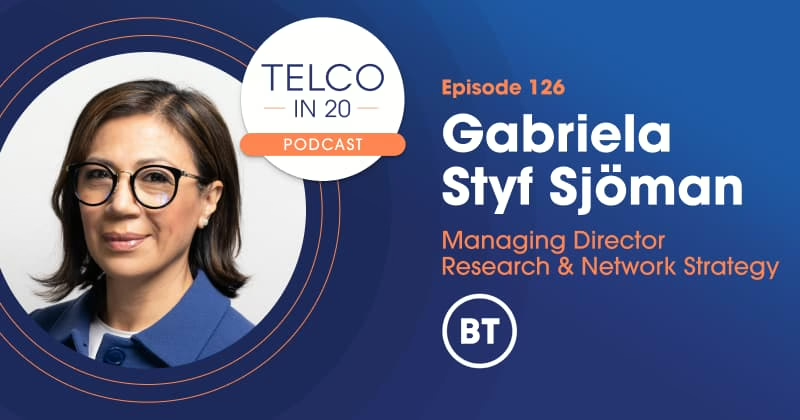
Ep 126 – AI for networks and networks for AI (Gabriela Styf Sjöman)
Gabriela Styf Sjöman from BT Group explains why telcos need to stop obsessing over technology and prioritize subscriber-centric business outcomes.
If AI is so awesome, why isn’t it having a bigger impact on your bottom line? I hate to break it to you, but the problem isn’t with AI—it’s with your leadership. Look no further than the quality of your ideas and capability of your execution to figure out why your team is not getting better results with AI.
In this episode, I sit down with strategic HR and transformation leader Jim Abolt. He has decades of experience helping organizations navigate major transformations successfully, and isn’t surprised that AI initiatives are failing to deliver. Listen to our conversation as we discuss the hard truths about “Big C” Change leadership, why you need big ideas and bold execution to be successful with AI, and why you should listen to me, DR, the “Disruptor Who’s Right.” We dive into how I’m delivering real results when it comes to implementing AI in my own organization.
Listen now to hear:
Wanna talk AI and public cloud? Telco execs, set up a meeting with our team to learn how to tap the immense business value it can bring.
Jim Abolt is a retired HR executive who is widely regarded as an expert in leadership development, culture shaping, and large-scale organizational change. His career spanned multiple industries, disciplines, and continents. Starting as a labor relations specialist in a Midwest steel mill, he ultimately held global senior management positions with leading companies in the consumer packaged goods, pharmaceutical, and software development industries. Jim holds an A.B. from Dartmouth College, and a J.D. and M.A. from the University of Illinois.
The Telco in 20 podcast is ranked in the top 5% of all podcasts globally by Listen Notes! 🎉 We’ve also won a 2024 MarComm Award, 2024 and 2025 Hermes Awards, and are recognized as a TeckNexus Top 12 Telco and Tech Podcast, Forrester Top 100 Channel Podcast and Feedspot Top 10 Telecom Podcast.
If you enjoy the podcast, would you leave us a review? It takes you seconds to do in your app and it really makes a difference in helping to convince hard-to-get guests. And I love reading your feedback and reviews!
 Get my FREE newsletter, delivered every two weeks, with curated content to help telco execs across the globe move to the public cloud.
Set up a meeting with our team to learn how to tap the immense business value it can bring.

According to Jim Abolt and Danielle Rios, telco AI failures stem from leadership problems, not technology issues. Specifically, AI initiatives fail because ideas aren’t big enough and execution isn’t bold enough. Most telcos treat AI as a cost-cutting tool targeting 2-5% improvements instead of a capability multiplier. The key is pursuing 10X transformations that fundamentally redesign work rather than simply augmenting existing processes. Success requires bold leaders who are willing to make major changes that current experts may resist. Learn more in Jim’s previous Telco in 20 episode, “How to build an AI-first organization.”
Totogi’s developers now generate up to 20,000 lines of code daily, compared to several hundred previously. This shift required both technological readiness—advanced LLMs with improved coding capabilities—and cultural transformation through change management. Danielle Rios emphasizes that developers should tell AI what they want rather than writing individual lines of code. Totogi’s breakthrough came from thinking about what will be possible in two to four years and working backward. Watch DR’s interview with Ray Le Maistre from TelecomTV where she discusses how coding with LLMs is approaching human-level capability, and read her blog on why telco is the perfect use case for AI-assisted development.
DR redesigned Totogi’s customer support by rejecting the augmentation approach (which would yield only 20% productivity gains) and instead asking, “what if AI solved 100% of tickets?” Starting at 5-6% automation, the team systematically tested AI on different products and problem sets, creating a flywheel effect. They soon reached 85% automation, reducing headcount costs almost one-for-one while improving service. This demonstrates how AI solutions can fundamentally transform operations rather than just enhance them.
“Shift left” means eliminating work from humans entirely rather than just augmenting them with AI tools. Jim Abolt praised DR’s blog on this concept, calling it the best he had read in years. The approach recognizes that we’re experiencing the biggest work transformation in history where every job will be redesigned. It requires brutal honesty about job elimination while also creating new opportunities. Organizations must be transparent with employees about changes coming so they can prepare and pursue AI training opportunities.
Jim Abolt describes DR as “a master of being brutally honest without being brutal.” Warning employees about the biggest work transformation in history isn’t reckless—it’s responsible and helpful. Workers need transparency to plan their futures, volunteer for AI opportunities, attend training, and prepare for transitions. Employees who embrace AI by learning new capabilities will remain valuable whether they stay with their current company or move elsewhere. Hiding the truth prevents people from adapting to inevitable changes.
Jim Abolt thinks like a business person who specializes in HR rather than just an HR expert—an approach inspired by Disney CEO Michael Eisner. This business-first mindset makes leaders more relevant, impactful, and effective at driving transformation. Joe Liemandt called Jim’s business advice among the most influential in his career on the “Invest Like the Best” podcast. For AI transformation specifically, this means understanding that leadership challenges—not technology limitations—prevent organizations from achieving the bold execution and big ideas necessary for real ROI from AI initiatives.