
 Apple Podcasts
  Spotify
  YouTube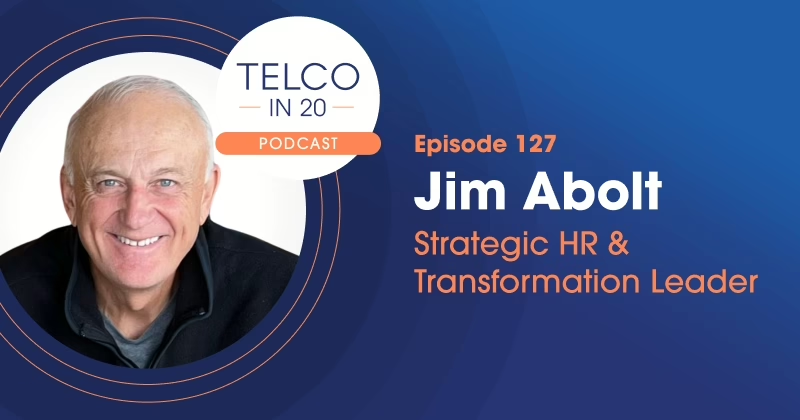
Ep 127 – The courage to change (Jim Abolt)
Strategic transformation leader Jim Abolt explains why telcos aren't seeing AI ROI and how to achieve real transformation by redesigning work instead of augmenting it.
The telco industry has been buzzing about AI transformation, but few operators have seen tangible results beyond pilot projects. The challenge isn’t just adopting new technology—it’s fundamentally changing how telcos build and maintain their business support systems (BSS).
For this special episode, I join Scott Bicheno and Iain Morris on the Telecoms.com podcast to discuss Totogi’s recent AI demonstration at TelecomTV’s AI-Native Telco Forum in Düsseldorf, Germany. This is one of our rare “double drops,” where both podcasts share the same conversation. We talk about Totogi’s live coding demonstration in Germany, which used AI and BSS Magic to generate over 600,000 lines of BSS code, explore the concept of ontology in AI systems, and dive into why telcos struggle with AI implementation. Fair warning: this episode is longer than usual, but we cover a lot of important topics.
Listen now to hear:
Wanna talk AI and public cloud? Telco execs, set up a meeting with our team to learn how to tap the immense business value it can bring.
The Telecoms.com Podcast is a weekly show produced by Telecoms.com and hosted by industry experts Scott Bicheno and Iain Morris. The format centers on irreverent and engaging discussions about current trends, controversies, and major news in the global telecommunications sector, often featuring special guests from telecom operators, vendors, and analysts.
As the Editorial Director of Telecoms.com, Scott Bicheno has been covering the mobile phone and broader technology industries for over 20 years. Prior to Telecoms.com, Scott was the primary smartphone specialist at industry analyst Strategy Analytics.
Iain Morris is the International Editor at Light Reading. Prior to boosting Light Reading’s UK-based editorial team numbers, he was a successful freelance writer and editor covering the telecom sector. He was previously the lead telecom analyst for the Economist Intelligence Unit.
The Telco in 20 podcast is ranked in the top 5% of all podcasts globally by Listen Notes! 🎉 We’ve also won a 2024 MarComm Award, 2024 and 2025 Hermes Awards, and are recognized as a TeckNexus Top 12 Telco and Tech Podcast, Forrester Top 100 Channel Podcast and Feedspot Top 10 Telecom Podcast.
If you enjoy the podcast, would you leave us a review? It takes you seconds to do in your app and it really makes a difference in helping to convince hard-to-get guests. And I love reading your feedback and reviews!
 Get my FREE newsletter, delivered every two weeks, with curated content to help telco execs across the globe move to the public cloud.
Set up a meeting with our team to learn how to tap the immense business value it can bring.

Totogi performed a live coding demonstration using AI and BSS Magic to generate over 600,000 lines of code in one day. The demonstration involved creating six BSS modules from scratch using one forward-deployed engineer and AI, making over 300 commits to production. This proof-of-concept showed that AI-assisted BSS development is achievable in real-time, addressing industry skepticism about AI’s practical capabilities in telecom software development.
Ontology in BSS Magic refers to the vocabulary of telecom—the nouns (subscriber, device, SIM, cell tower) and verbs (onboarding, deactivating, provisioning) specific to the industry. This context engineering gives AI the guardrails and business logic needed to understand telecom operations. BSS Magic’s ontology layer expects to interact with BSS systems and knows telecom deeply, enabling it to generate appropriate code without requiring developers to specify every detail.
DR recommends starting with customer support rather than network applications, as it’s safer and less risky. Customer support tickets contain structured data with human-generated correct answers from previously solved issues. Build a retrieval-augmented generation (RAG) database on solved tickets, start with easy use cases like password resets, and gradually tackle harder problems. This approach lets organizations learn AI implementation while minimizing risk to core operations.
Users need AI expertise—specifically understanding how to work with AI development tools and prompt engineering—as well as telco knowledge. However, Totogi has encapsulated much of the telco knowledge needed in BSS Magic’s ontology layer, reducing the burden on operators. The forward-deployed engineer acts as an architect, scheduling work and monitoring AI progress rather than writing code line-by-line. They guide the AI through sophisticated prompts while BSS Magic handles the technical implementation.
Scott and Iain expressed skepticism about over-reliance on public cloud providers, particularly after the December 2024 AWS US-EAST-1 outage that took down numerous websites including Telecoms.com and Light Reading. However, DR countered that resilience is a shared responsibility—companies choosing US-EAST-1 are accepting higher risk for lower cost. She explained that proper architecture with redundancy across multiple AWS regions prevents such outages, and companies can build resilience for relatively modest additional investment compared to maintaining private infrastructure.
Iain Morris raised concerns about developers becoming too removed from their own code when using AI, citing a LinkedIn post from an experienced developer who felt “helpless” modifying AI-generated code he had directed. Scott shared this skepticism about losing underlying human competence. Both hosts worried about what happens when AI can’t solve a problem and humans need to step in. DR acknowledged veteran developers often resist AI-generated code but argued this represents a natural evolution—like moving from punch cards to higher-order programming languages—where developers work at a higher level of abstraction.