 Apple Podcasts
  Spotify
  YouTube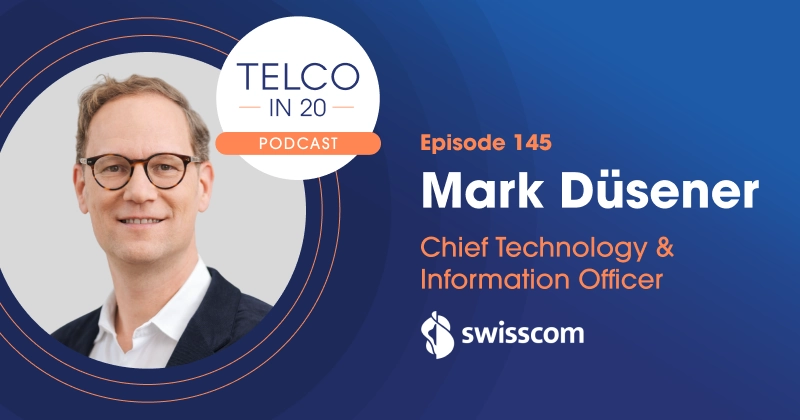
Ep 145 – Swisscom is building the AI-first telco (Mark Düsener)
Swisscom’s CTIO Mark Düsener shares how the operator is rebuilding its digital core for the AI era.
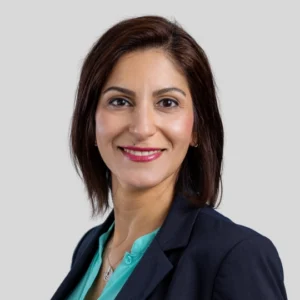
It’s hard to manage a network in space. That constraint shapes everything Dr. Mariam Kaynia thinks about as chief data and information officer at Eutelsat, Europe’s only LEO alternative to Starlink in orbit today. The company runs more than 600 satellites at 1,200 kilometers alongside a geostationary fleet parked even higher. When Eutelsat launches a satellite, the intelligence running it has to be right before it leaves the ground: self-calibrating, self-healing, and autonomous by design, not by choice.
I sat down with Mariam to unpack why satellite is becoming core connectivity instead of the backup layer, how Eutelsat federated its data platforms instead of ripping them out, and where AI decisions should—and should NOT—live inside an operator.
Listen now to hear:
Wanna talk AI and public cloud? Telco execs, set up a meeting with our team to learn how to tap the immense business value it can bring.
Mariam Kaynia is Eutelsat’s chief data and information officer and a member of the group’s Executive Committee. She oversees IT, data, and AI for the group. She brings extensive telecommunications expertise from VP roles at Telefónica Germany, where she led digital transformation, strategy, and data analytics, and from her time as an associate partner at McKinsey & Company. Named among the Top 50 Women in Technology in Germany, she holds a Ph.D. in Wireless Communications and Electrical Engineering from the Norwegian University of Science and Technology.
The Telco in 20 podcast is ranked in the top 5% of all podcasts globally by Listen Notes! 🎉 We’ve also won 2026, 2025, and 2024 Hermes Creative Awards, 2025 and 2024 MarCom Awards, and are recognized as a TeckNexus Top 12 Telco and Tech Podcast, Forrester Top 100 Channel Podcast, and Feedspot Top 10 Telecom Podcast.
If you enjoy the podcast, would you leave us a review? It takes you seconds to do in your app and it really makes a difference in helping to convince hard-to-get guests. And I love reading your feedback and reviews!
 Get my FREE newsletter, delivered every two weeks, with curated content to help telco execs across the globe move to the public cloud.
Set up a meeting with our team to learn how to tap the immense business value it can bring.

Eutelsat had multiple data platforms built over time. Rather than ripping them out, Chief Data and Information Officer Mariam Kaynia’s team opened up the architecture and connected them, adding shared data governance, a data catalog, and data products. This gave the company transparency and speed without a disruptive rebuild, freeing the team to focus on AI use cases that actually create value rather than on infrastructure cleanup.
Once a satellite launches, no one can send a technician to fix it, so Eutelsat builds AI directly into orbit. Models predict and prevent collisions, plan avoidance maneuvers, recalibrate systems, and optimize fuel for both operations and eventual de-orbiting. On the ground, one agent classifies incidents and another performs root-cause analysis. This work earned Eutelsat the TM Forum Catalyst “Tech for Good” award for a multi-orbit AI prototype built with Airbus, Bell Canada, and MTN Nigeria.
Both operate low Earth orbit satellites, but their markets differ. Starlink focuses on mass-market, consumer home connectivity, while Eutelsat is B2B and B2G, serving telecom operators, enterprises, and governments. The company sometimes acts as a B2B2X partner that helps other providers deliver the right connectivity mix. Eutelsat delivers a “mobile network from the sky” with higher speeds and lower latency, anywhere terrestrial networks can’t reach.
In places like Greenland, low population density makes it costly for terrestrial network build outs, even though the need is real. Eutelsat partners with local telecom operators to extend connectivity to these remote communities via satellite, giving residents access that would otherwise be economically out of reach, while also helping telcos serve areas they couldn’t profitably cover alone.
DR argues that when decisioning happens purely through inference, outputs become hard to audit and inconsistent—ask the same question twice and you may get different answers. Instead, her company, Totogi, captures a business’s rules and valid decisions in a governed model, then layers generative AI on top. She unpacks this in her blog, “Where do decisions live?”
DR argues that AI decisions become hard to audit when they’re made purely at inference time. The Totogi Ontology fixes this by capturing every business rule in one governed model, so when AI acts, companies can show regulators and customers exactly which rule fired and why.