
 Apple Podcasts
  Spotify
  YouTube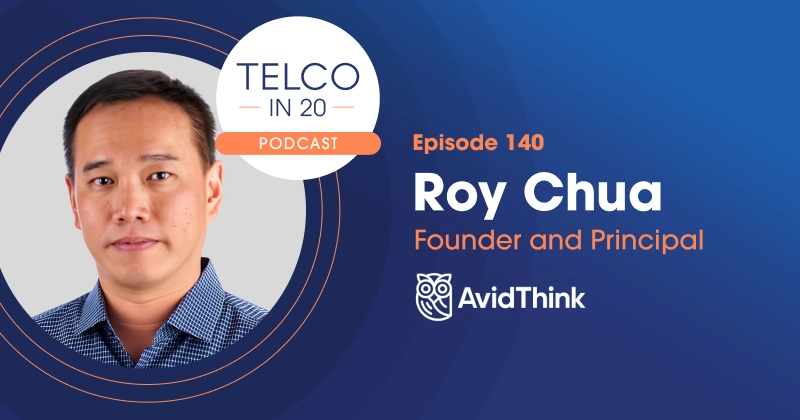
Ep 140 – Will telco let AI write its code? (Roy Chua)
AI is rewriting the rules of software engineering. Roy Chua of AvidThink breaks down what that means for telco.
Every operator made the same bet—go digital, close stores, turn over distribution to the resellers. Somewhere along the way, they gave away the customer relationship. In the first half of 2025, data usage grew in 92% of markets while ARPU grew in only 50%. Operators are delivering more yet earning less.
Tele2 is fighting back. It’s opening physical stores while everyone else is closing them, consolidating six IT stacks down to two, and using AI to rebuild subscriber relationships at scale. For this episode, I talk with Ove Wik, EVP and CTIO at Tele2, about what it takes to reclaim customer relationships, why most BSS transformations never get finished, and what real change actually takes.
Listen now to hear:
Wanna talk AI and public cloud? Telco execs, set up a meeting with our team to learn how to tap the immense business value it can bring.
Ove is CTIO at Tele2. He has spent his entire life in telecom operators, starting in Sweden at a time when one incumbent provided fixed telephony. He has navigated more than 40 years of telco evolution that has included intense competition, extensive product portfolios, and international operations.
With a background in engineering, Ove has worked in technology, product management, sales, operations, and strategy. Some of his international assignments have included COO at Yoigo Spain, Head of Transformation at Salt Switzerland, and Head of Digital Enablement at Veon Group. For more than 25 years, he has worked to drive change through a combination of technology, organization, and culture.
The Telco in 20 podcast is ranked in the top 5% of all podcasts globally by Listen Notes! 🎉 We’ve also won 2026, 2025, and 2024 Hermes Creative Awards, 2025 and 2024 MarCom Awards, and are recognized as a TeckNexus Top 12 Telco and Tech Podcast, Forrester Top 100 Channel Podcast, and Feedspot Top 10 Telecom Podcast.
If you enjoy the podcast, would you leave us a review? It takes you seconds to do in your app and it really makes a difference in helping to convince hard-to-get guests. And I love reading your feedback and reviews!
 Get my FREE newsletter, delivered every two weeks, with curated content to help telco execs across the globe move to the public cloud.
Set up a meeting with our team to learn how to tap the immense business value it can bring.

Tele2 was founded as a challenger brand to compete against Sweden’s incumbent monopoly. Over time, like most operators, it ceded the subscriber relationship to handset manufacturers and resellers. CEO Jean-Marc Harion’s declaration that the company is going “back to the future” to rebuild subscriber relationships at scale.
Tele2 applied one disciplined question to every process, business rule, and legacy exception: “Does this affect what the customer sees?” If the answer was no, it made the bold decision to consolidate and move on. That customer-first filter, combined with strong architectural conviction and change management, is what separated its successful transformation from projects that never get finished.
The shift to digital and reseller-led distribution left operators as commodities, with handset manufacturers and resellers owning the customer relationship. Tele2 is reversing course—opening stores to rebuild direct subscriber contact. Combined with AI-driven personalization, this physical presence helps them understand customer needs, deliver better offers, and capture a larger share of subscriber spending directly.
When Sweden’s incumbent Telia was denied a 3G license, Telia and Tele2 were effectively forced to cooperate, using Tele2’s license to build a shared network. That became one of the world’s first radio network joint ventures. Today, Net4Mobility — the JV with Telenor — has reached 99.9% 5G population coverage in Sweden, proving that network sharing can produce world-class infrastructure even without the scale of larger markets.
DR points out that operators too often treat transformation as a technology swap—changing systems one at a time while leaving business processes and rules intact. Ove Wik, who spent five years transforming multiple markets at Veon before joining Tele2, reinforces this: real BSS transformation requires an end-to-end grip on the full business, processes, and customer interactions all at once. The 20% of edge cases and legacy exceptions that don’t affect customers are what turn two-year projects into decade-long ones.
Most operators enter a transformation guessing which processes actually matter to customers. The Totogi Ontology removes the guesswork. It maps your business processes, rules, and customer interactions so everything is visible and connected in one place. That clarity lets you confidently identify the 80% that drives your business, understand the true cost of the 20% that doesn’t, and make trade-offs with full context instead of internal politics.