
 Apple Podcasts
  Spotify
  YouTube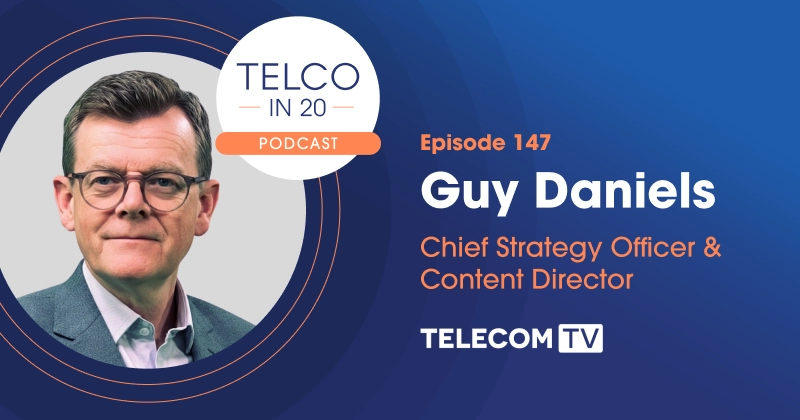
Ep 147 – ANTA: TelecomTV’s AI-Native Telco Accelerator (Guy Daniels)
Telco isn’t behind on AI. TelecomTV’s Guy Daniels shares the evidence and introduces TelecomTV’s new AI-Native Telco Accelerator.
To G, or not to G. That is the question every telco faces, and the 6G noise is getting louder. So how does that decision actually get made?
Stefan Pongratz, vice president of RAN and telecom CapEx research at Dell’Oro Group, has watched operators wrestle with it through 16 years and three G cycles. He knows what it really costs, what’s on the boardroom chart, and why waiting has a price of its own. He also knows what makes this cycle different, and why the operators dimensioning their networks for humans might be planning for the wrong customer.
Listen now to hear:
Wanna talk AI and public cloud? Telco execs, set up a meeting with our team to learn how to tap the immense business value it can bring.
Stefan Pongratz joined Dell’Oro Group in 2010 and leads the firm’s Mobile RAN market research programs. At the firm, Mr. Pongratz has expanded RAN research and authored multiple Advanced Research Reports to ensure the program evolves to address new RAN technologies and opportunities, including 5G, 6G, AI RAN, Open RAN, private wireless, Massive MIMO, mmWave, small cells, and CBRS. Before joining Dell’Oro Group, Mr. Pongratz spent 10 years at Anritsu Company.
The Telco in 20 podcast is ranked in the top 5% of all podcasts globally by Listen Notes! 🎉 We’ve also won 2026, 2025, and 2024 Hermes Creative Awards, 2025 and 2024 MarCom Awards, and are recognized as a TeckNexus Top 12 Telco and Tech Podcast, Forrester Top 100 Channel Podcast, and Feedspot Top 10 Telecom Podcast.
If you enjoy the podcast, would you leave us a review? It takes you seconds to do in your app and it really makes a difference in helping to convince hard-to-get guests. And I love reading your feedback and reviews!
 Get my FREE newsletter, delivered every two weeks, with curated content to help telco execs across the globe move to the public cloud.
Set up a meeting with our team to learn how to tap the immense business value it can bring.

Operators have spent roughly $2.5 trillion on wireless CapEx over the past 15 years (excluding spectrum)—about $150–170 billion a year, or 15–17% of industry revenue. As Dell’Oro’s Stefan Pongratz explains, the real choice isn’t between spending big on 6G or spending nothing; it’s between spending on the next G or continuing to spend on an aging one. See the numbers behind this in the Dell’Oro press release on global telecom CapEx.
It comes down to spare network capacity, competitive dynamics, technology maturity, and subscriber demand trends. Historically, a new G hasn’t generated incremental revenue; instead, it lowers the cost of delivering each bit as traffic keeps growing. Operators weigh the return on deploying the new G against the return on staying put, then decide whether they can afford to wait or need to move now.
AI. For the first time, machines and AI agents—not just humans—are becoming network customers, which changes both traffic volume and traffic patterns, since machines don’t sleep. Dell’Oro’s base case is that 6G will be evolutionary rather than revolutionary, but thanks to AI, the odds it becomes more than “just another G” are higher than with any previous generation.
Operators tend to move as a herd. Being an early follower isn’t necessarily a problem—until the leader visibly delivers a better user experience, lower cost per bit, more agility, or AI-driven capabilities and starts gaining market share. At that point, competitive pressure accelerates quickly, as seen historically with Vodafone and Sprint in European 4G and T-Mobile and Reliance Jio in 5G.
Most operators size upgrades by traffic, but the busiest sites aren’t always the most profitable ones. DR points to a smarter approach: building a live P&L for every cell site and ranking upgrades by revenue rather than raw traffic. The Totogi Ontology does exactly this, and Totogi already has a Latin American customer using it to decide where to invest. Shaving even one point off the CapEx-to-revenue ratio could free $11 billion industry-wide.
Danielle Rios will keynote and host a party at TelecomTV’s AI-Native Telco Forum in Düsseldorf on September 8–9, and she’ll join VIVA Bolivia CEO Ryan Alvarez for a fireside chat at TM Forum’s Innovate Americas in Dallas on October 6, digging into which sites operators should *not* upgrade. She also recently published a blog on AI watermarking, arguing the EU’s new rule flags who typed the words, not who thought them.