
 Apple Podcasts
  Spotify
  YouTube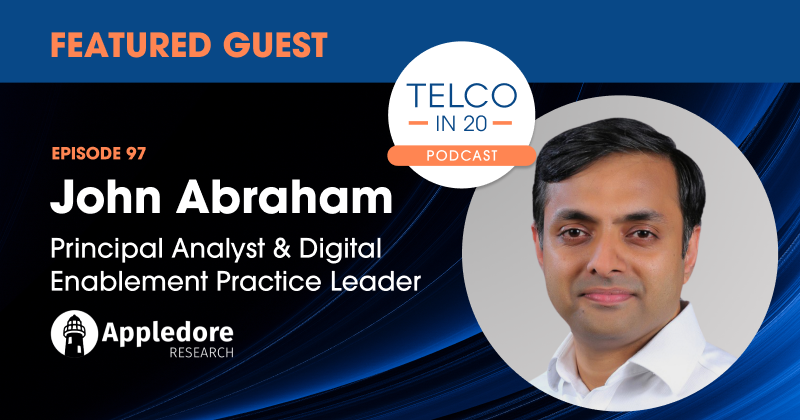
Ep 97 – The big trends in BSS with Appledore Research
John Abraham from Appledore Research discusses how vendors and operators are applying GenAI in their business, major BSS trends, and how the cost of AI can be justified by real business outcomes.
In 2007, Safaricom PLC (Safaricom) and Vodafone invented M-PESA, a mobile payment system that has transformed financial services in Kenya and beyond by bringing banking capabilities to unbanked populations. M-PESA has become a cornerstone of the Kenyan economy and helped Safaricom build a reputation for innovation.
In this episode, I’m talking with Fawzia Ali, chief consumer business officer at Safaricom. We discuss the success of M-PESA, the company’s efforts to use AI and machine learning for continued innovation, and how it’s preparing its workforce for an AI-driven future. Listen now to hear:
Wanna talk AI and public cloud? Telco execs, set up a meeting with our team to learn how to tap the immense business value it can bring.
Fawzia Ali is a transformational commercial leader in the FMCG and telecommunications sectors, currently serving as the chief consumer business officer at Safaricom PLC, a leading technology company in Africa. With an impressive track record of success and a deep understanding of the ever-evolving consumer landscape, Fawzia plays a pivotal role in shaping Safaricom’s customer-centric strategy and driving the company’s growth in the competitive technology sector. She leads a diverse and talented team focused on creating value for Safaricom’s customers.
The Telco in 20 podcast won 2024 and 2022 Hermes Awards, 2023 and 2022 MarComm Awards, and was recognized as a TeckNexus Top 12 Telco and Tech Podcast, Forrester Top 100 Channel Podcast and Feedspot Top 10 Telecom Podcast. If you enjoy the podcast, would you leave us a short review? It takes you seconds to do in your app and it really makes a difference in helping to convince hard-to-get guests. And I love reading your feedback and reviews!
 Get my FREE newsletter, delivered every two weeks, with curated content to help telco execs across the globe move to the public cloud.
Set up a meeting with our team to learn how to tap the immense business value it can bring.

M-PESA is a mobile payment system invented by Safaricom and Vodafone in 2007 that transforms feature phones into portable banks. It allows users to transfer money as easily as sending a text message, serving Kenya’s previously unbanked population. Its success stems from understanding a real societal need, keeping the technology simple enough to work on 2G phones, creating wide distribution with over 250,000 agents, opening the platform to 70,000+ developers through APIs, and operating in a supportive regulatory environment. Today, 59% of Kenya’s GDP flows through M-PESA, with 75 million daily transactions.
Safaricom is implementing AI-driven hyper-personalization to optimize revenue and improve customer experience. Its approach starts with data cleansing and creating a single view of each customer across all devices and services. It has built approximately 95 machine learning models and is testing AI-enabled propositions with small customer cohorts. As host Danielle Rios discussed at MWC23, the key is starting small, iterating quickly based on results, and moving away from one-size-fits-all campaigns to truly personalized offers based on individual customer behavior patterns.
Safaricom tests AI initiatives using small customer cohorts rather than blasting campaigns to everyone. This allows the company to understand specific customer behaviors, minimize risk from potential negative effects, and iterate quickly based on results. It’s moving toward automating customer prompts based on learned behaviors, so the system can trigger personalized actions without manual intervention. Fawzia Ali emphasizes that this requires changing telco culture from traditional mass-marketing approaches to trusting that AI and machine learning actually work.
Safaricom has made AI training mandatory for all employees as part of its 2030 vision. Every employee must complete an interactive online AI course and pass an exam by at least 80%, and each division must implement an AI-enabled initiative to improve customer experience. It uses a “two plus one” approach: two essential company-wide skills (AI and human-centered design) plus one division-specific skill. Currently, 80% of employees have completed the AI course, creating organizational excitement about experimentation and demonstrating the company’s commitment to reskilling its workforce.
Totogi provides AI-powered solutions that help telcos generate hyper-personalized plans, identify new revenue streams, and pull insights from data. As DR explains, Totogi’s approach focuses on experimenting rapidly with small customer groups to test machine learning models, refine strategies, and iterate for outstanding results. The platform helps telcos shift from traditional one-size-fits-all marketing to data-driven personalization. Interested telco executives can connect with DR on LinkedIn or X @TelcoDR to learn more.
According to Fawzia Ali, most telcos have significantly enhanced their networks, making network quality less of a differentiator. Product offerings are also becoming increasingly homogeneous across carriers. The next competitive battleground is hyper-personalization—understanding customers holistically across all their devices and services, their lifestyle, family situation, and usage patterns. This requires clean data, a single customer view, and AI capabilities to deliver the right offer at the right time through the right channel, treating customers as individuals rather than numbers.