
 Apple Podcasts
  Spotify
  YouTube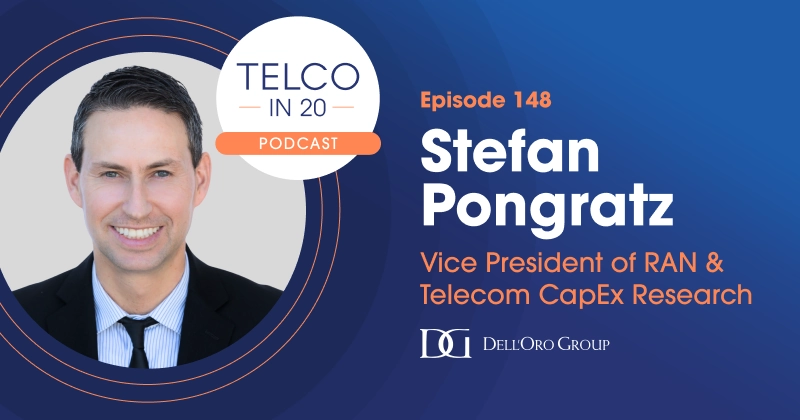
Ep 148 – To G, or not to G (Stefan Pongratz)
Dell’Oro Group analyst Stefan Pongratz breaks down the real economics of moving to a new G—and what makes the 6G cycle different.
Every telco has hundreds of AI use cases, dozens of pilots, thousands of agents. So why can’t they get to production at scale?
I sat down with Kevin Shatzkamer, corporate vice president of the Telco and Media Engineering Studio at Microsoft Frontier Company, the hyperscaler’s new operating unit. His team embeds forward-deployed engineers (FDEs) at enterprise customers to build and run AI at scale.
Listen now to hear:
Wanna talk AI and public cloud? Telco execs, set up a meeting with our team to learn how to tap the immense business value it can bring.
Kevin Shatzkamer is a corporate vice president of engineering at Microsoft Frontier Company, leading the Telco and Media industry verticals and customer experience transformation across industries. With more than 20 years of experience driving AI, digital transformation, and technology innovation, he partners with customers to design and scale enterprise AI solutions that deliver measurable business outcomes. Prior to Microsoft Frontier Company, he led Strategy and Operations for Microsoft’s Customer Experience & Success organization. Kevin is the author of two technology books, holds more than 50 patents, and earned degrees from the University of Florida, MIT, and Indiana University.
The Telco in 20 podcast is ranked in the top 5% of all podcasts globally by Listen Notes! 🎉 We’ve also won 2026, 2025, and 2024 Hermes Creative Awards, 2025 and 2024 MarCom Awards, and are recognized as a TeckNexus Top 12 Telco and Tech Podcast, Forrester Top 100 Channel Podcast, and Feedspot Top 10 Telecom Podcast.
If you enjoy the podcast, would you leave us a review? It takes you seconds to do in your app and it really makes a difference in helping to convince hard-to-get guests. And I love reading your feedback and reviews!
 Get my FREE newsletter, delivered every two weeks, with curated content to help telco execs across the globe move to the public cloud.
Set up a meeting with our team to learn how to tap the immense business value it can bring.

The Microsoft Frontier Company is a $2.5B, 6,000-engineer bet on embedding teams inside customers. The unit’s engineers work directly inside customer environments to co-design, co-deploy, and continuously improve AI systems, with success measured by business outcomes rather than shipped software. Read Microsoft’s Frontier launch announcement and learn what Frontier Company offers in its outcomes-first model.
According to Kevin Shatzkamer, AI rarely fails in the demo. It breaks down at the operational seams: fragmented data, decades of legacy systems, regulatory obligations, and workflows spanning network, customer care, field service, security, and commercial operations. A model can perform well in isolation yet still fail without business context, permissions, observability, and escalation paths, which is why telcos need to treat AI adoption as a structural capability, not a point solution.
Frontier teams start with a business outcome, not a model. They observe how work actually runs—not just documented processes—to spot where people compensate for missing context, where approvals stall, and where risk enters the system. From there, they identify the smallest production workflow that proves the new operating model, run it, and build learning loops for quality, adoption, and business results before scaling further.
Kevin Shatzkamer argues it’s not the AI model, the cloud, the data, or even engineering capacity. It’s transformation capacity, or how fast an idea can move from pilot to production. Telcos already have hundreds of use cases, dozens of pilots, and thousands of agents; the challenge is building the operating discipline to turn that activity into measurable, scaled outcomes rather than accumulating more proofs of concept.
Danielle Rios notes that Totogi already builds this way: forward-deployed engineers work alongside customers with twice-weekly capability sprints, turning feedback into shipped code within days rather than months. It’s the same “idea to production” gap Kevin Shatzkamer describes closing for telco customers through the Microsoft Frontier Company, built on short, capability-driven cycles instead of multi-year transformation programs.
In her takeaway, Danielle Rios suggests asking one question: what’s our cycle time from idea to production? If the answer is months, the issue isn’t AI—it’s transformation capacity. DR unpacks this further with VIVA Bolivia CEO Ryan Alvarez, who runs every cell site as its own P&L on the Totogi Ontology, at TM Forum’s Innovate Americas in Dallas, Texas, on October 6, 2026.