 Apple Podcasts
  Spotify
  YouTube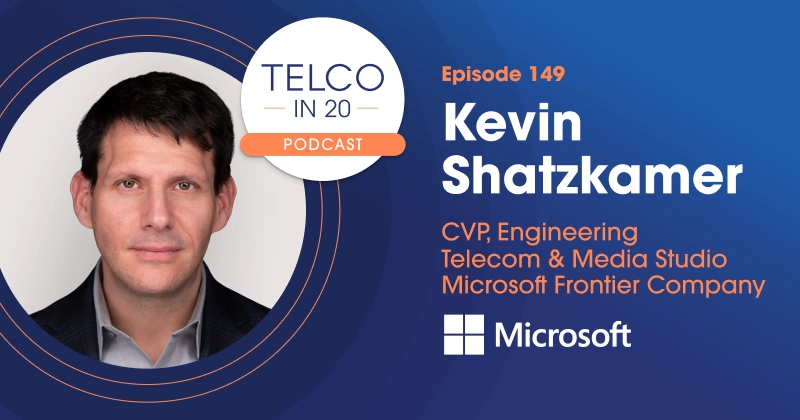
Ep 149 – Microsoft deploys the FDEs (Kevin Shatzkamer)
Microsoft’s Kevin Shatzkamer on how telcos can speed the move from AI pilots to production, and the new engineering model making it happen.
Every ten years, telcos have to decide whether to move to the next G. The business case has always been based on usage, capacity, and a revenue forecast. That’s because the one number that should drive the decision—what each cell actually earns—has been out of reach… until now.
In this special What’s Up with Totogi episode, I share the keynote I delivered at TelecomTV’s AI-Native Telco Forum in Düsseldorf. In it, I cover how AI finally makes that number visible, how one operator in Bolivia is using the Totogi Ontology to rank every site by the profit it earns, and how AI is changing the way telcos can make the 6G call.
Listen now to hear:
Wanna talk AI and public cloud? Telco execs, set up a meeting with our team to learn how to tap the immense business value it can bring.
Danielle Rios (DR) is the founder and CEO of TelcoDR and Totogi, and host of the Telco in 20 podcast.
The Telco in 20 podcast is ranked in the top 5% of all podcasts globally by Listen Notes! 🎉 We’ve also won 2026, 2025, and 2024 Hermes Creative Awards, 2025 and 2024 MarCom Awards, and are recognized as a TeckNexus Top 12 Telco and Tech Podcast, Forrester Top 100 Channel Podcast, and Feedspot Top 10 Telecom Podcast.
If you enjoy the podcast, would you leave us a review? It takes you seconds to do in your app and it really makes a difference in helping to convince hard-to-get guests. And I love reading your feedback and reviews!
 Get my FREE newsletter, delivered every two weeks, with curated content to help telco execs across the globe move to the public cloud.
Set up a meeting with our team to learn how to tap the immense business value it can bring.

Every previous generation was decided using two numbers: measurable network traffic and forecasted revenue. Operators could always measure usage, but the profitability side was guesswork, since no system could calculate real return per site. AI closes that gap. For the first time, telcos can calculate expected profit before committing billions in capital, which is why this upgrade cycle is described as the first one “decided with AI in the room.” Read the full argument in the blog, The first G with AI in the room.
Every tower generates two numbers: how much traffic it carries, and how much money it makes. Telcos have always been able to measure the first—usage is real, site-by-site data. But profitability has historically been a forecast, since the information needed to calculate it—subscriber activity, billing, plan revenue, and cost allocation—lives scattered across systems that don’t share a common language, making true per-site profit nearly impossible to calculate.
The Totogi Ontology is an AI-built map of a telco’s systems, standardized on TM Forum’s Autonomous Networks framework, which automatically rebuilds itself every night as systems change. It connects scattered data, such as an IMSI, a billing account, and a CRM customer record, into a single view, so operators can calculate real profitability per site rather than relying on traffic alone. See how the Totogi Ontology builds a live P&L for every cell site, ranking them by the money each one actually makes.
Telstra, Swisscom, and Verizon are each independently building a version of the same “shared language” layer to unify how their systems define common concepts like a subscriber. Roughly 90% of this map is identical across the industry, since a subscriber in Zurich and one in Seattle are structurally the same. Hear how each operator frames the challenge in the episodes with Swisscom’s Mark Düsener and Telstra’s Mark Sanders.
VIVA Bolivia has built a single model of its business that connects traffic and profitability data for every site and cell, ranking them by actual profit rather than raw usage. That lets leadership check the return on a potential upgrade at any time, instead of waiting on an annual consultant study. Catch VIVA CEO Ryan Alvarez discussing these upgrade decisions live at TM Forum’s Innovate Americas in Dallas on October 6.
This episode is Danielle Rios’s keynote from TelecomTV’s AI-Native Telco Forum in Düsseldorf. She’ll also be discussing these ideas live with VIVA Bolivia’s CEO at TM Forum’s Innovate Americas in Dallas on October 6.