 Apple Podcasts
 Spotify
 YouTube
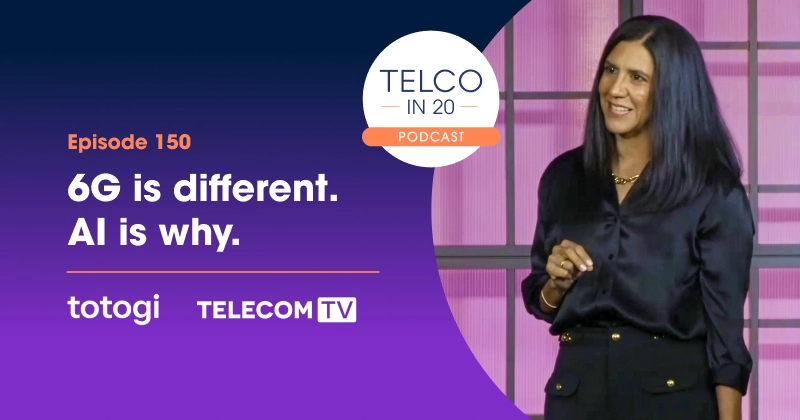
Ep 150 – 6G is different. AI is why.
DR takes the main stage at TelecomTV’s AI-Native Telco Forum to tackle the 6G decision—and the one number telcos have never been able to see.
I’ve been a guest on the Telecoms.com podcast three times, and the dynamic never changes: hosts Scott Bicheno and Iain Morris see doom, I see upside. This year, Scott admitted he’s bored of his own dystopia and wanted someone to argue the other side. So he brought me in to talk AI.
We get into why one number can mean two completely different things inside the same telco, why the SaaSpocalypse is real and Salesforce should be nervous, and why I think the Totogi Ontology is the fix for telco’s AI problem. Three rounds in, we still don’t agree on everything, and that’s what makes it so fun!
Listen now to hear:
Wanna talk AI and public cloud? Telco execs, set up a meeting with our team to learn how to tap the immense business value it can bring.
The Telecoms.com Podcast is a weekly show hosted by industry experts Scott Bicheno and Iain Morris. The format centers on irreverent and engaging discussions about current trends, controversies, and major news in the global telecommunications sector, often featuring special guests from telecom operators, vendors, and analysts.
As the editorial director of Telecoms.com, Scott Bicheno has been covering the mobile phone and broader technology industries for over 20 years. Prior to Telecoms.com, Scott was the primary smartphone specialist at industry analyst Strategy Analytics.
Iain Morris is the international editor at Light Reading. Prior to boosting Light Reading’s UK-based editorial team numbers, he was a successful freelance writer and editor covering the telecom sector. He was previously the lead telecom analyst for the Economist Intelligence Unit.
The Telco in 20 podcast is ranked in the top 5% of all podcasts globally by Listen Notes! 🎉 We’ve also won 2026, 2025, and 2024 Hermes Creative Awards, 2025 and 2024 MarCom Awards, and are recognized as a TeckNexus Top 12 Telco and Tech Podcast, Forrester Top 100 Channel Podcast, and Feedspot Top 10 Telecom Podcast.
If you enjoy the podcast, would you leave us a review? It takes you seconds to do in your app and it really makes a difference in helping to convince hard-to-get guests. And I love reading your feedback and reviews!
 Get my FREE newsletter, delivered every two weeks, with curated content to help telco execs across the globe move to the public cloud.
Set up a meeting with our team to learn how to tap the immense business value it can bring.

Teams often share a metric’s label but calculate it differently. Danielle Rios describes a Totogi customer where network and finance both reported ARPU, yet used different formulas. The same happens with the meaning of “customer,” which network, billing and other systems define differently. Connecting those systems to the Totogi Ontology exposed the mismatch, so the telco can fix it right away instead of launching a multi-year data-cleanup project before starting AI.
The Totogi Ontology is a model of how a telco works, built from interviews with the operator’s own experts, and it sits on top of existing BSS, OSS, network and finance systems. According to Danielle Rios, it doesn’t use AI to invent rules. If a situation isn’t captured, it doesn’t act. Every decision has an audit trail showing which rule fired and who owns it.
VIVA Bolivia connects network, charging, plan and marketing data through the Totogi Ontology to build a profit-and-loss view of every cell. Instead of relying on a consultant’s once-a-year slide, leaders can ask which towers are profitable before committing to a roughly $300 million 4G-to-5G upgrade. The goal is to invest by revenue, not just capacity. Read how VIVA Bolivia is deciding network investment.
Because 6G is the first generation where operators can decide with money in view. Past G decisions relied on capacity data and consultant business cases. With AI and a data layer such as the Totogi Ontology, a telco can model costs and revenue at the cell level before upgrading. Read DR’s blog, “The first G with AI in the room,” and watch her AI-Native Telco Summit keynote.
Danielle Rios argues that AI makes it easy to vibe-code a replacement CRM. A company could build its own front end on top of Salesforce’s API, migrate functionality over time, and eventually use Salesforce as only a database before swapping it out. She doesn’t expect this overnight, noting that customers are already seeing unusual discounts. Hear the full debate on the Telecoms.com podcast.
DR warns that GPUs have roughly 18-month life cycles, not the five years telcos are used to, because better chips keep arriving. This pace is often called Huang’s Law. Enterprises buying AI workloads won’t want chips from three years ago, and the capital treadmill is heavy. She asks whether telcos are ready to fund it before chasing GPU-as-a-service.